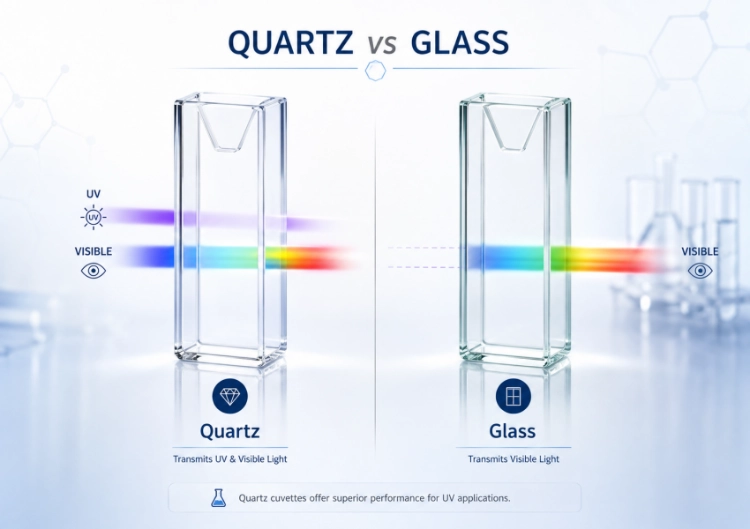
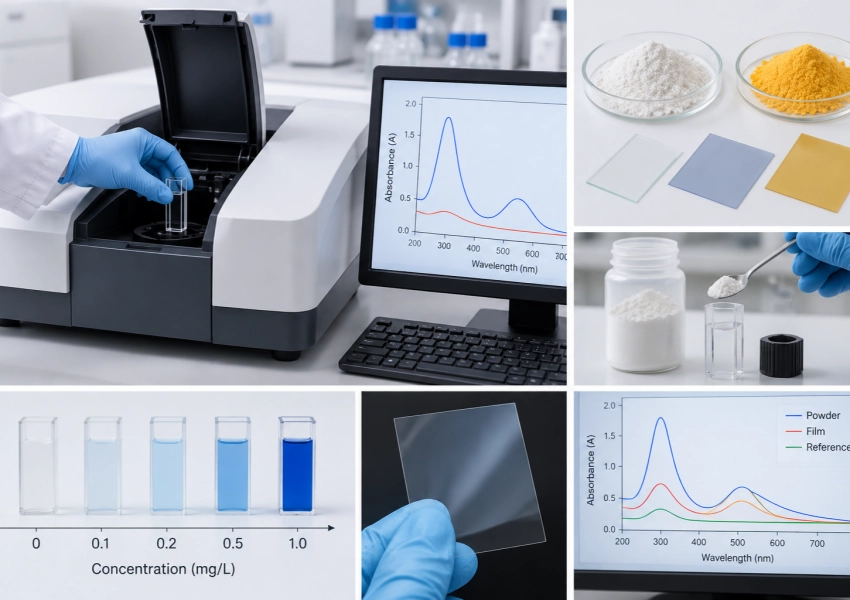
Powders and films do not behave like clear solutions in a standard cuvette. A powder can scatter, settle, compress, or present different packing densities from one preparation to the next. A film can transmit light, reflect it from one or both surfaces, or show a strong angle and thickness effect. The right solid sample UV-Vis setup therefore starts with the signal being measured, not with a familiar liquid method copied onto a different sample form.
For a procurement or method-development team, three questions come first: is the result based on direct transmission, diffuse reflection, total reflection, or a combination of these; how will the sample be positioned; and what reference will define the measurement? Those decisions affect the accessory, the instrument optics, the repeatability study, and the way results should be reported.
Separate Absorbance From Scattering
A clear solution mainly changes the intensity of light passing through it. A powder can also redirect light away from the detector, while a rough or coated film can produce both diffuse and specular components. Calling every decrease in detector signal absorbance can create a misleading concentration result. The method should state whether the useful output is an absorbance spectrum, a transmission spectrum, a diffuse reflectance spectrum, or a reflectance value at selected wavelengths.
Fix the Sample Before Fixing the Settings
A repeatable result depends on more than wavelength and bandwidth. Record powder particle condition, packing or pellet preparation, exposed area, film thickness, surface orientation, angle, and the number of replicate positions. If the sample is flexible, warped, or visibly nonuniform, measure more than one area. A stable instrument cannot compensate for a sample that presents a different optical path at every reading.
How to Measure Powders
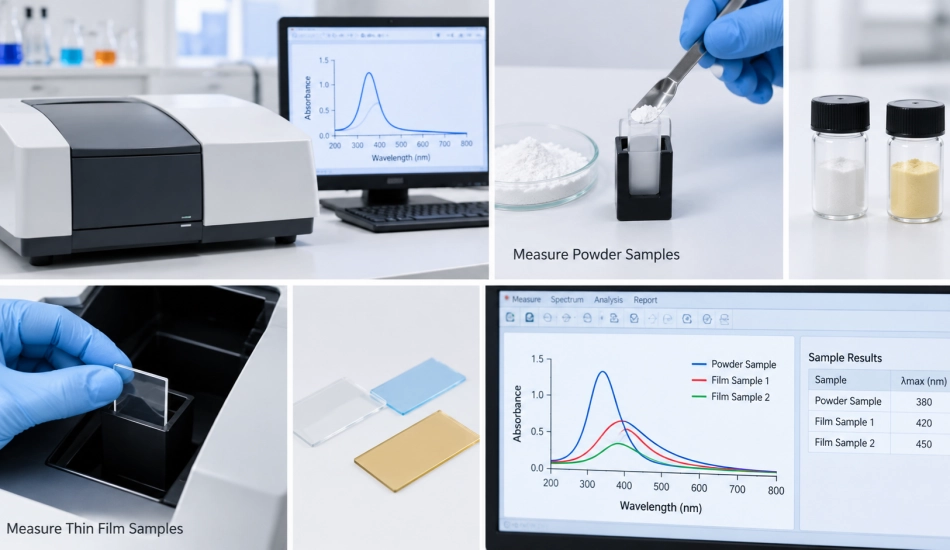
Powder work normally falls into two practical routes. The first uses a solid holder or a defined pellet to study the material in a controlled optical path. The second uses reflectance geometry, often with an integrating sphere, when scattering is part of the sample behavior or when a direct transmission path is not realistic.
Use a Solid Holder for Defined Positions
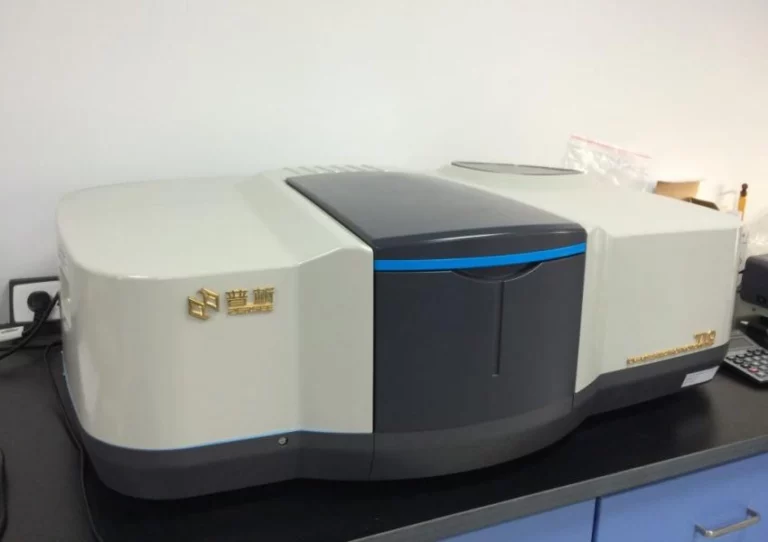
A solid sample holder is useful when a slice, pellet, or prepared solid can be fixed across the beam. PERSEE’s T9DCS UV-Vis is designed for slicing solid samples, while the T8DCS UV-Vis supports solid samples below 5 mm thick and allows the position to be changed within a stated angle range. Such hardware helps the laboratory control the beam position rather than holding a powder or film by hand.
Use Reflectance When Scattering Is Part of the Result
UV-Vis reflectance measurements are a better fit when the sample surface or powder scatters light and a normal cuvette path would lose useful information. An integrating sphere can collect light over a wider range of directions and support diffuse reflectance, total transmission, total reflection, and scattering transmission measurements. The reference material, port geometry, sample coverage, and sphere configuration still need to be fixed in the method. An integrating sphere does not make a poorly prepared powder uniform.
How to Measure Films
Film measurements are often easier to interpret when the geometry is treated as part of the sample description. A transparent film may be tested for direct transmission. A coated optical surface, opaque film, or hazy polymer may call for specular or diffuse reflectance. The same film can give different results when its front and back surfaces, angle, backing material, or exposed area changes.
Control Thickness, Angle, and Backing
Film transmittance should be tied to thickness or at least to a clearly defined production condition. Keep the film flat and centered, remove wrinkles, and document whether the measurement includes a substrate. If the substrate contributes appreciable absorption or reflection, measure it separately and use a reference that matches the intended calculation. For coated lenses and similar surfaces, a specular reflection accessory may be more informative than a transmission holder.
Check Uniformity Across the Surface
One spectrum can hide coating streaks, pinholes, pigment agglomerates, or edge effects. Use a small position map for development work and define how many positions are needed for routine release or incoming inspection. Report the selected area and orientation. If the result is used to compare batches, the same fixture, reference, and measurement sequence matter as much as the nominal wavelength.
Select the Instrument and Accessories Together
An instrument may have the wavelength range needed for a powder or film and still be a poor fit if its sample compartment cannot accept the required geometry. The T8DCS combines double-beam optics with a continuously selectable 0.1-5 nm bandwidth and a sample compartment designed for optional accessories. Its listed accessories include solid sample holders, specular reflectance accessories, and an integrating sphere, making it a practical platform for method development that may move between solution, film, and solid work.
For more demanding reflectance or high-range applications, the T9DCS is specified with a large sample compartment suitable for 60 mm and 150 mm integrating spheres, an adjustable beam size, and continuously selectable bandwidth from 0.1-5 nm. Its optical design is listed with very low stray light at 220 nm. The T7DS UV–Vis spectrophotometer is another double-beam option when routine scanning, wavelength work, and flexible accessories are the main priorities. PERSEE can be compared by sample geometry, optical range, and accessory support before a final configuration is selected. Final selection should be based on the actual sample size, optical geometry, wavelength range, and repeatability target.
Build a Repeatable Solid-Sample Workflow
A useful procedure records the reference, sample presentation, position, angle, aperture or beam size, wavelength settings, bandwidth, and number of replicates. Run a reference before the sample series and check that the reference response is still credible after the series. For powders, compare replicate preparations when packing is part of the uncertainty. For films, compare locations and thickness information. If a result depends on a backing plate or substrate, keep that component in the reference design rather than treating it as an afterthought.
Verify the Method With Real Samples
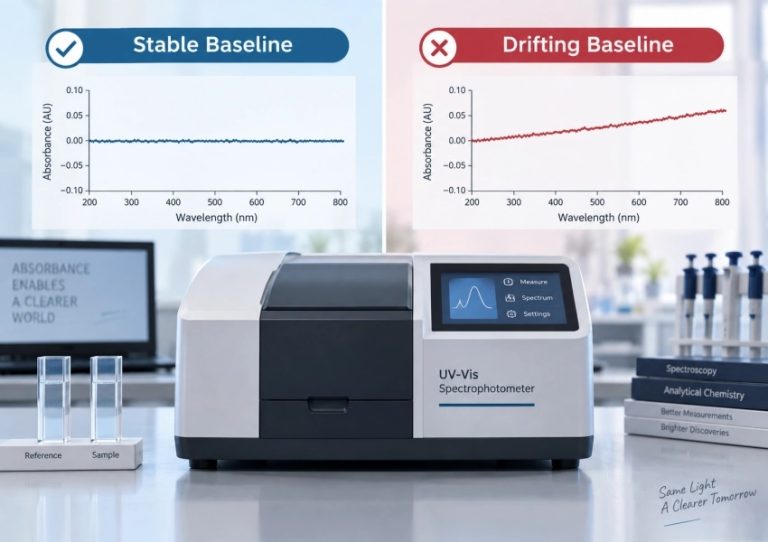
Instrument specifications can confirm that a platform has the needed optical functions, but they do not establish a universal acceptance limit for every powder or film. Use representative materials, including the roughest, most opaque, thinnest, and least uniform samples expected in routine work. Review the effect of bandwidth and beam size before locking the method. A lower noise trace is useful only when the sample geometry is also controlled.
FAQ
Q1: Can a powder be measured in the same way as a clear liquid?
A1: Usually not. Powder scattering and packing can change the detected signal, so a solid holder, defined pellet method, reflectance setup, or integrating sphere may be more appropriate than a standard liquid cuvette.
Q2: When is an integrating sphere useful for a film?
A2: It is useful when diffuse transmission, total transmission, or reflection matters, especially for hazy, scattering, coated, or non-flat samples. The sphere geometry and reference must be specified with the method.
Q3: What should be confirmed before purchasing a solid-sample UV-Vis setup?
A3: Confirm sample size, thickness, surface type, transmission or reflectance mode, angle range, sphere size, wavelength range, beam adjustment, and the number of routine positions. A representative sample demonstration is more informative than a liquid standard alone.