
A UV-Vis procedure can be technically sound and still fail in pharmaceutical QC if its validation package does not match the job it is meant to perform. An identification check, an assay, a dissolution reading, and a cleaning-verification method do not carry the same risk. That is why UV-Vis validation begins with a defined purpose, expected concentration range, sample matrix, acceptance approach, and reportable result. The instrument is part of the evidence chain, but it is not the whole chain.
For a method transferred into routine use, begin by separating three questions. Is the spectrophotometer performing as intended? Does the analytical procedure measure the target response in this matrix? Can the laboratory execute the procedure repeatedly with traceable records? That distinction keeps spectrophotometer validation from becoming a loose collection of checks with no connection to the release decision. It also gives UV-Vis validation a clear link to the release decision.
Qualification, Calibration, and Method Validation Are Different
Installation and operational checks show that the equipment is configured and performing within its intended capability. Calibration or performance verification supports wavelength, photometric, and other instrument checks. A documented spectrophotometer validation plan makes those checks repeatable. Analytical method validation establishes that the full procedure is fit for its intended use. A passed wavelength check does not prove extraction recovery. A good calibration curve does not prove selectivity against placebo or degradation products. In pharma QC, the protocol should state how each layer is documented and how deviations are assessed. That separation is central to analytical method validation during transfer.
Start With Instrument Performance That Can Affect the Result
Before working through the analytical parameters, verify the optical behavior that can bias the measurement. The exact standards, frequency, and limits belong to the site’s approved procedure and applicable requirements. They should not be copied from a product brochure or borrowed from an unrelated assay.
Wavelength Accuracy, Photometric Response, and Stray Light
Wavelength accuracy matters when a method measures a peak, shoulder, or prescribed wavelength. Photometric accuracy and absorbance linearity matter when the reported result is calculated from absorbance. Stray light can become material at higher absorbance and may flatten the apparent response. Spectral bandwidth affects peak shape and quantitative error when a sample has narrow absorbance features. A practical UV-Vis validation plan identifies which of these risks apply to the method rather than treating every check as identical in importance.
PERSEE‘s T8DCS is relevant for pharmaceutical and research applications because its bandwidth is continuously selectable from 0.1 to 5 nm, it uses a photomultiplier detector, and its true double-beam optical system is intended for high stability and low background noise. Those capabilities support method development choices, but the laboratory still needs to select and justify the bandwidth used in the final procedure.
Baseline, Noise, and Measurement Timing
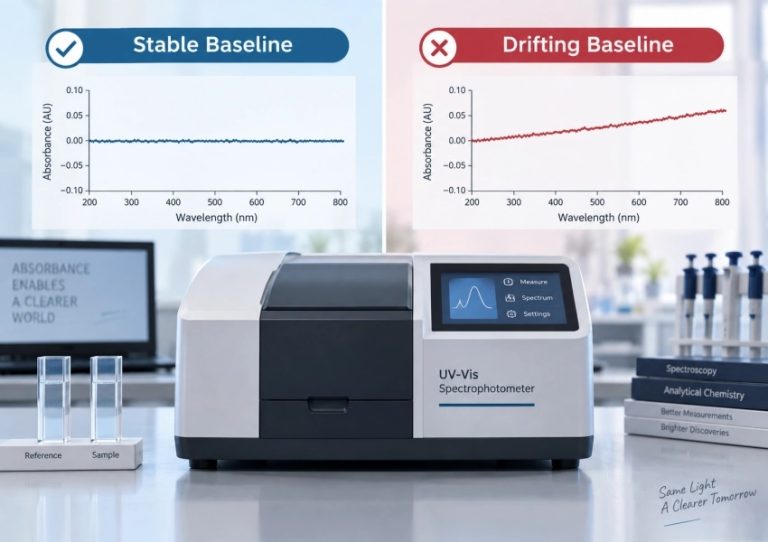
A stable baseline under the intended conditions is especially important for low absorbance work and long sequences. Check the blank over a time window that resembles a real batch. Noise, drift, cell positioning, solvent temperature, and carryover from a sipper or accessory can all affect precision. If the method depends on a fixed delay after dilution or a defined temperature, place that condition in the procedure and test it during robustness work. A stable display after a short warm-up is not enough evidence for a four-hour sample set.
Method Parameters That Matter Most in Pharma QC
The familiar parameter list is useful only when it is tied to risk. The laboratory should justify inclusion, exclusion, range, number of levels, and acceptance criteria based on the analytical purpose and its quality system. Do not claim a universal set of limits for every pharmaceutical UV-Vis method.
Specificity and Accuracy
Specificity asks whether the signal belongs to the intended analyte under the stated conditions. Blank, placebo, excipient, forced-degradation, or interference studies may be relevant depending on the method. Accuracy then asks whether the reported value is close enough to a suitable reference value across the working range. For a sample requiring extraction or dilution, accuracy must cover those operations too. A standard solution alone can make the method look better than the finished-product workflow.
Precision, Linearity, and Range
Repeatability should include the normal preparations, not just repeated reads from one cuvette. Intermediate precision may compare analysts, days, instruments, or critical conditions when those sources of variation are realistic. Linearity considers whether response and concentration are suitably related over the claimed range, while range connects that evidence to the concentrations that will actually be reported. Plot review matters. A high correlation statistic does not automatically reveal a poor low-end fit, a preparation error, or a curve driven by one high point.
Robustness, Detection Capability, and Solution Stability
Robustness work probes the conditions likely to vary in routine use: wavelength setting, bandwidth, timing, temperature, analyst technique, and, where justified, different cell sets or reagent lots. Detection and quantitation capability are relevant when the method’s intended use requires low-level measurement; they are not generic badges to add to every assay. Solution and blank stability deserve similar attention. A response that changes after preparation may be a chemistry issue, not an instrument issue.
Data Integrity Is Part of the Validation Evidence
A technically valid result is difficult to defend if raw files, methods, user actions, and changes cannot be reconstructed. Pharma QC should define who may create, edit, approve, and review methods; where files are stored; how backups are handled; and what happens when an acquisition is interrupted. These controls need to match the laboratory’s quality system and validated computerized-system requirements.
Link User Roles to Real Workflows
For teams using PC-connected UV-Vis systems, user controls should be tested in the same way the laboratory works. UVWin software supports analyst user groups, privilege settings, password-based login, and automatic audit-trail logging. The UV-Vis IQ/OQ/PQ qualification kit is also a relevant product discussion when the QC workflow needs documented qualification activity. The site must still assess configuration, electronic-record requirements, and procedure fit before making any compliance claim.
Review the Raw Evidence, Not Only the Printed Result
A review should include blank and standard traces where relevant, sample preparation records, sequence order, calculation settings, invalidation rationale, and any remeasurement. When the result is generated from a spectrum rather than a single wavelength, retain the information needed to confirm wavelength selection and baseline treatment. A clear review path reduces the temptation to repeat a questionable reading until a preferred number appears.
Match the Platform to the Method, Then Prove the Method
Instrument choice affects how comfortably a laboratory can run and investigate a procedure. The T9DCS is specified with an adjustable slit, automatic wavelength correction using an integrated mercury-emission lamp, and listed low stray-light performance of no more than 0.00004%T with NaI at 220 nm. Its application material also identifies use in metrology verification with standard filters and potassium dichromate solutions. Those features may be relevant for difficult optical work, but final acceptance must be based on the QC method and the laboratory’s qualification plan.
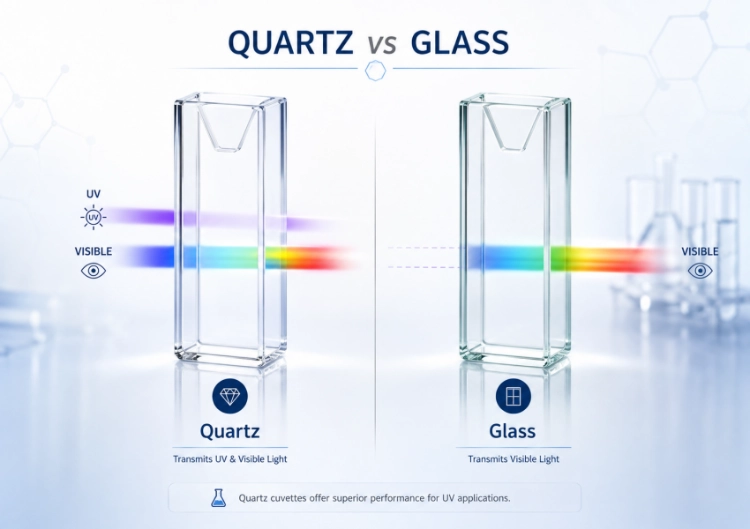
For methods needing general UV-Vis capability with accessories and routine data work, review the molecular spectrometer category alongside the intended sample volume, cuvette path length, temperature needs, wavelength range, throughput, and record controls. A purchase evaluation is stronger when it uses the actual placebo, reference standard, blank, and expected concentration range rather than a generic demonstration sample.
FAQ
Q1: Is instrument calibration the same as UV-Vis method validation?
A1: No. Instrument checks support the reliability of the measurement platform. Method validation covers the complete analytical procedure, including sample preparation, matrix effects, calculations, and routine execution.
Q2: Which parameter is most often overlooked in a UV-Vis QC method?
A2: Baseline stability over the real sequence length is often under-tested. It can affect low-level results, repeatability, and the interpretation of blank-corrected data.
Q3: What should be confirmed before buying a UV-Vis system for pharma QC?
A3: Confirm the wavelength and absorbance range, bandwidth needs, expected sample throughput, accessories, qualification support, user-access workflow, data-review requirements, and performance with representative materials. PERSEE can be evaluated against that checklist.