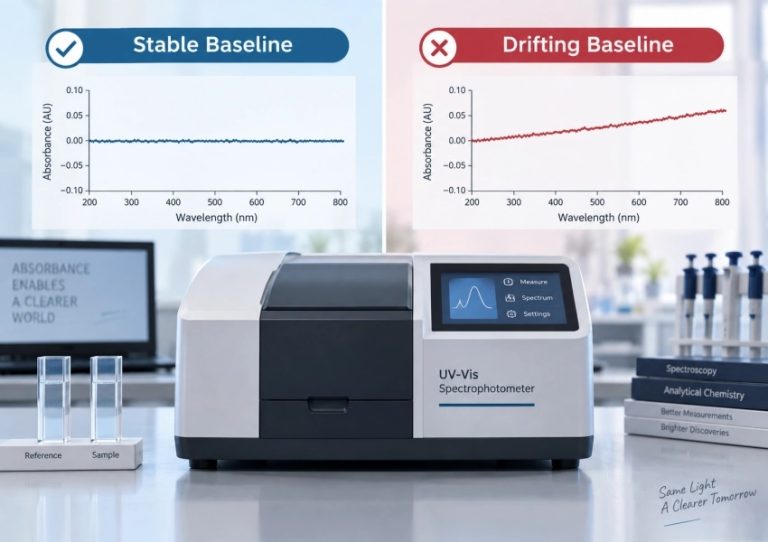
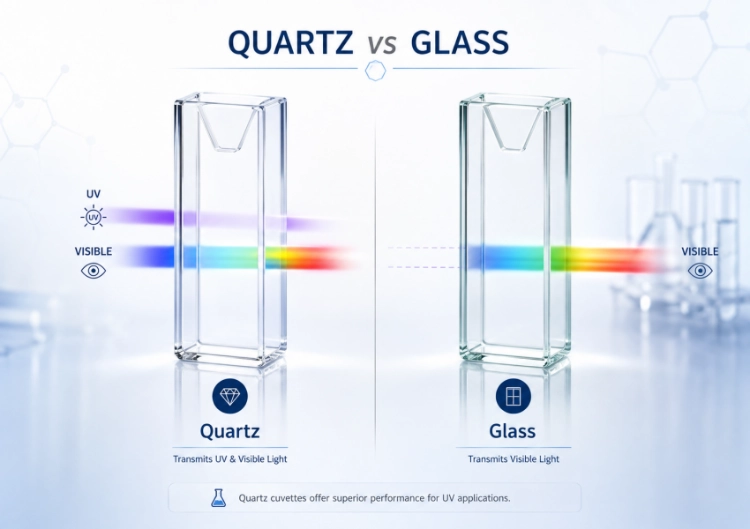
A cuvette is a small part of a UV-Vis workflow, but it sits directly in the light path. Its material, path length, surface condition, and fit inside the holder can change the result before the software has anything to calculate. That is why the quartz vs glass cuvette decision belongs in method setup and purchasing, not at the end of an instrument order.
The practical choice starts with wavelength. Quartz is the safer choice when the method reaches into the ultraviolet or when UV transmission is part of the measurement. Glass can be sensible for routine visible-range work, provided the method, solvent, cell quality, and instrument holder all support it. The right answer is therefore a match between the sample and the measurement, rather than a universal preference for one material.
What Changes When the Cuvette Material Changes
The cuvette has to transmit the selected light with low and repeatable interference. A material that works well in one part of the spectrum may be a poor choice in another. In practice, the first screening question is simple: does the validated method use ultraviolet wavelengths, or does it stay in the visible region?
UV Range Is the First Filter
For UV measurements, a quartz cuvette is normally the starting point because UV transparency is a central requirement. This matters in spectral scans, low-level absorbance work, and methods in which the selected wavelength sits close to the lower end of the instrument range. The cuvette should be specified together with the actual wavelength window, solvent, path length, and required optical quality.
A useful application example comes from riboflavin testing: the method uses a 1 cm quartz cuvette for spectral scanning. The point is not that every food or pharmaceutical method needs quartz. It is that the cell material follows the wavelength and method design. A replacement cell should be checked against the same conditions instead of being treated as a visually identical spare.
Visible Routine Work Is More Forgiving
For visible-range assays, glass may be adequate when the method does not require UV transmission and the laboratory can control cell-to-cell variation. This can be practical for routine color, concentration, or process checks. Even here, matching cells, clean optical windows, and consistent orientation matter more than the label on the box.
A glass cell is not automatically a lower-risk purchase. If the same laboratory also runs UV methods, keeps multiple solvents, or expects the instrument to support future assays, a mixed stock of glass and quartz can create avoidable selection errors. The purchasing specification should state the intended wavelength range and application instead of listing only ‘UV Vis cuvette’.
Match the Cuvette to the Method, Not Just the Instrument
An instrument may cover a broad wavelength range, while an individual cuvette does not suit every part of that range. Method transfer should record the material, path length, clear aperture, volume requirement, and cleaning procedure. Those details make repeat measurements easier to reproduce between operators and between laboratories.
Wavelength, Solvent, and Sample Chemistry
Start with the analytical wavelength, then check the solvent and sample matrix. Organic solvents, strong reagents, suspended particles, and sticky samples can change the cleaning burden or shorten cell life. The supplier should confirm chemical compatibility for any unusual solvent or aggressive preparation step. A cell that transmits the right light but cannot tolerate the sample workflow is not a practical choice.
Path Length and Sample Volume
The familiar 10 mm path length is common, but it is not the only useful format. Low-volume samples may call for a micro or ultra-micro holder; dilute samples may benefit from a longer path length if the method supports it. Longer cells also demand more careful filling, cleaning, and bubble control. These are method decisions, not accessories to add after installation.
The cell holder must match the cell geometry. For example, the double-beam microcell holder listed for the T8DCS platform is intended for cells above 0.1 mL with a 10 mm path length, while its long-path holder accommodates multiple path lengths. Such details are valuable during procurement because they connect sample volume and method sensitivity to a real hardware configuration.
Optical Quality and Daily Handling Matter
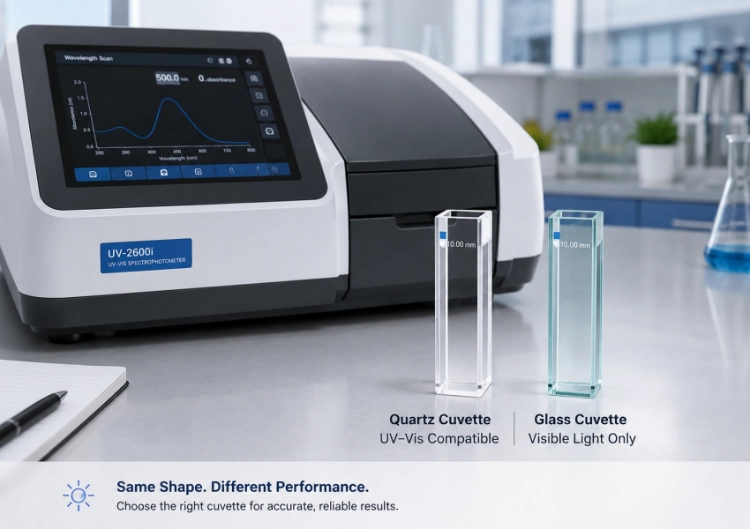
Material alone does not decide data quality. Scratches, fingerprints, residue, cloudy windows, and inconsistent placement can produce more trouble than the difference between two good cells. A laboratory that buys premium cells but handles them by the optical windows has simply moved the risk to a different part of the workflow.
Surface Condition and Orientation
Mark one optical orientation and keep it consistent when the cell design requires it. Inspect the clear faces under suitable light before use. Reject cells with visible damage, persistent haze, or residue that survives the approved cleaning procedure. For quantitative work, compare a new lot with the current lot using a blank and a representative standard before releasing it for routine testing.
Cleaning and Replacement
The cleaning procedure should reflect the material and the sample chemistry. Rinsing immediately after measurement is usually easier on the cell than allowing a film to dry. Abrasive tools and improvised solvents can damage surfaces or leave a film that changes the blank. Keep separate handling rules for quartz and glass when the lab uses different cleaning agents or different assays.
Check Cell Holder and Workflow Compatibility
The best cuvette on paper can be the wrong purchase if it does not seat correctly or if the laboratory workflow requires an accessory the instrument cannot accept. Check holder dimensions, beam height, path length, usable aperture, sample volume, and whether the holder is manual, thermostatic, flow-through, or motorized.
Fixed Holders Versus Special Accessories
For a compact routine platform, the T6U UV–Vis is specified with a 190-1100 nm operating range and a fixed 2 nm spectral bandwidth. Its listed accessories include an 8-position 10 mm motorized holder, a universal 5-position 5-100 mm holder, and an SQ10/10 quartz cell package. That combination suits a lab that values straightforward routine work but still needs more than one cell format.
A broader instrument range is useful only when the cell path remains usable at the selected wavelength. The molecular spectroscopy instrument category provides a sensible starting point for comparing platforms, but the purchase specification should still name the actual holder and cell configuration.
Throughput and Temperature Control
High-throughput labs should ask how quickly cells can be loaded, aligned, emptied, and cleaned. A multi-cell holder may reduce handling, but only if every position uses compatible cells and the method controls blank and sample order. Temperature-sensitive work needs a thermostatic arrangement and a cell designed for that holder, not simply a glass or quartz cell placed into a standard slot.
For methods that change with temperature or need small sample volumes, the T8DCS double-beam platform lists optional thermostatic, micro, ultra-micro, and long-path cell holders. Its continuously selectable 0.1-5 nm spectral bandwidth can also support method-specific spectral work, but the chosen cell and holder still have to be qualified under the actual procedure.
A Practical Buying Decision for the Lab
Choose quartz when UV transmission, a UV method, or future UV expansion is important. Choose glass for suitable visible-range routines when the method does not need UV transmission and the laboratory can maintain consistent cell quality. Keep the decision conditional: wavelength, solvent, sample volume, path length, optical condition, and holder compatibility should all agree.
Questions for the Supplier
Before purchase, ask for the recommended cell material at the method wavelength, dimensional tolerances, path-length options, compatible holders, cleaning limits, and replacement availability. For a lab moving between routine and research work, the T9DCS UV-Vis spectrophotometer and the PERSEE can be evaluated by accessory fit as well as by the main optical specification. Any unconfirmed wavelength cutoff, solvent limitation, or certification requirement should remain a supplier-confirmation item in the final quotation.
A short acceptance check is worthwhile: run the blank, compare a representative standard in the proposed cell lot, verify the cell sits at the intended beam position, and repeat the measurement after cleaning. Record the material and path length in the method or worksheet. That small discipline prevents a surprisingly common failure mode: a result that changes because the cell was changed without the method being changed.
FAQ
Q1: Is a quartz cuvette always better than a glass cuvette?
A1: No. Quartz is the safer choice for UV-range work, while glass can be suitable for visible-range routines that do not require UV transmission. The method wavelength and sample chemistry should decide.
Q2: Can any quartz cuvette be used in any UV-Vis spectrophotometer?
A2: No. Check path length, external dimensions, clear aperture, beam height, sample volume, and holder compatibility. Micro, long-path, thermostatic, and motorized holders may have different requirements.
Q3: What should a buyer confirm before ordering replacement cells?
A3: Confirm material, wavelength range, path length, solvent compatibility, dimensional fit, cleaning limits, lot consistency, and replacement supply. A blank and representative-standard check should be part of incoming acceptance for quantitative work.