Food and beverage labs rarely need a single perfect instrument. They need an instrument that matches the sample, the method, the staff, and the pace of daily release work. A UV-Vis spectrophotometer for food quality control is often chosen because it gives fast absorbance-based results for color, additives, preservatives, sugars, enzymes, vitamins, flavor-related compounds, and other routine checks. The hard part is not deciding whether UV-Vis is useful. It is choosing the right level of optics and workflow before the instrument starts sitting in a busy QC room.
For many teams, the buying question starts with sample reality. Thin beverages, diluted syrups, clear extracts, digested samples, and colorimetric assays behave very differently from turbid juices, dairy matrices, oil-rich foods, or high-absorbance concentrates. If the sample preparation is simple and the target compound has a stable absorbance response, UV-Vis food testing can save time. If matrix interference is heavy, the instrument still matters, but the method design matters just as much.
Start With the Tests the Lab Runs Every Week
A practical selection process begins with the weekly test list, not the catalog. Food and beverage quality control may include additive checks, preservative assays, flavor compound monitoring, fat-related color reactions, glucose or enzyme testing, mineral-related methods, vitamin assays, and batch-to-batch color control. Some labs only need fixed-wavelength photometric readings. Others need spectrum scans, kinetic curves, multi-wavelength work, or quantitative calibration methods that different technicians can repeat without rebuilding the setup each time.
Routine Absorbance Checks
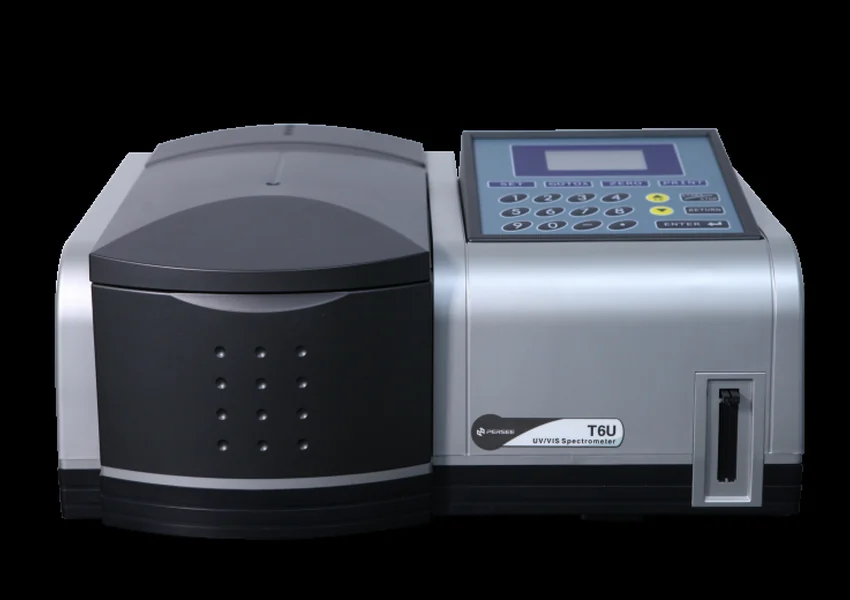
If the lab mainly handles routine incoming checks and release testing, speed and repeatability carry more weight than advanced features that rarely get used. A compact split-beam system such as T6U suits many straightforward methods because it covers 190-1100 nm, uses deuterium and tungsten light sources, and keeps the optical path simple enough for daily operation. Its fixed 2 nm spectral bandwidth, low stray light of 0.05%T, wavelength accuracy of 1 nm, and local control for fixed-wavelength photometry make it a sensible entry point for routine food and beverage quality control.
That does not mean every food lab should buy the simplest model. If the method list includes narrow absorption peaks, regulatory method transfer, or more demanding quantitative work, instrument resolution and software control become more important. A laboratory spectrophotometer selection should therefore separate three groups of tests: simple routine checks, method-development work, and difficult samples that push absorbance range or stray-light performance.
Match Optical Performance to the Sample, Not Just the Budget
The optical system determines how much confidence a lab can place in small absorbance differences. In UV-Vis food testing, a batch may pass or fail because a color reaction is slightly outside the specification. A wide spectral bandwidth can flatten peaks and shift calibration behavior. Very low signal levels may suffer if the noise is high. High absorbance samples may lose linearity if stray light is not tightly controlled.
When Bandwidth Starts to Matter
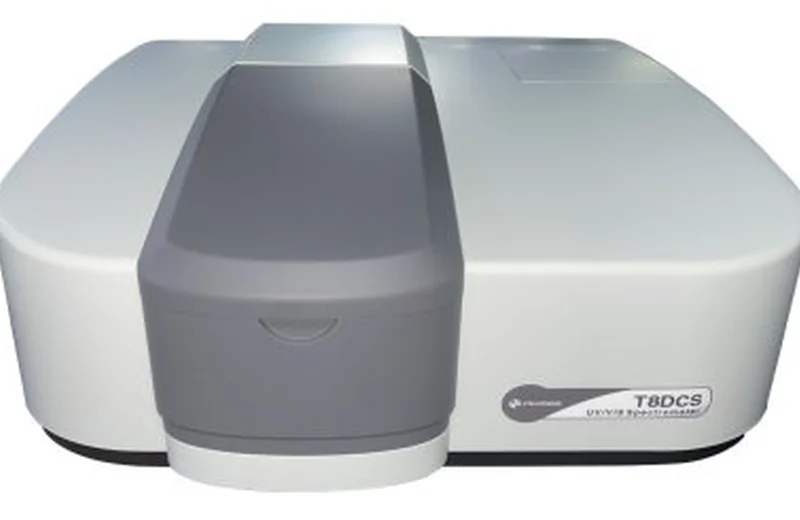
For methods that need stronger resolution control, T8DCS brings a true double-beam optical system, photomultiplier tube detection, and continuously selectable spectral bandwidth from 0.1 to 5 nm. This matters when the same instrument has to serve several assay types, from broader routine absorbance checks to narrower peaks where bandwidth must be tightened. UV-Win software is supplied as standard, so method handling, data processing, and report control fit better into a QC environment than a purely local-control setup.
For beverage labs, this can be useful when the instrument has to move between color, clarity, preservative, vitamin, and enzymatic assays. The method may look simple on paper, but daily use often brings small variations: different cuvettes, changing operators, warm sample racks, and batches with more background color than expected. A double-beam setup and stable electronics help reduce drift during longer runs.
Check Wavelength Range, Stray Light, and Bandwidth Together
Wavelength range alone can be misleading. A spectrophotometer for beverage analysis may need UV wavelengths for preservatives or vitamins, visible wavelengths for color work, and stable scanning for method comparison. But range is only one part of the instrument choice. Low stray light is critical when working at low wavelengths or high absorbance. Bandwidth matters when peaks are narrow. Wavelength reproducibility matters when methods are transferred between sites or repeated over months.
PERSEE lists the analytical instruments portfolio around molecular spectroscopy, atomic spectroscopy, chromatography, mass spectrometry, water purification, and related lab systems. Within the UV-Vis line, the step from T6U to T8DCS and then to higher-end double-monochromator models is not just a price ladder. It reflects different levels of optical control. That is useful for QC managers who need to justify why one lab can use an entry model while another site needs a more capable double-beam unit.
When Low Stray Light is Worth Paying for
For demanding samples, T9DCS is a higher-level option. Its optical design reaches ultra-low stray light of no more than 0.00004%T at 220 nm with NaI, supports a photometric range from -8.0 to 8.0 Abs, and offers continuously selectable spectral bandwidth from 0.1 to 5 nm. Nitrogen-purged optics can support deep UV measurement, while the integrated mercury emission lamp helps with automatic wavelength correction. This level is not necessary for every beverage plant. It becomes relevant when methods are strict, samples absorb strongly, or the lab also handles research, verification, and cross-industry work.
Look at Sample Handling Before Buying Accessories
Accessories can either make routine work smoother or become expensive shelf items. A food lab should map how samples move through the day. Are operators measuring single cuvettes, batches of eight, micro-volume samples, long path-length cells, temperature-sensitive reactions, or solid and opaque samples? Does the method need a sipper pump to reduce manual pipetting? Is temperature control required for enzyme work or reaction kinetics?
Accessories that Affect Daily Throughput
T6U can be paired with accessories such as a sipper pump, constant temperature holder, solid sample holder, test tube holder, motorized cell changers, Peltier module, and long path-length cell holder. T8DCS and T9DCS support broader accessory choices, including micro cell holders, long path-length holders, integrating sphere options, thermostatic holders, adjustable solid sample holders, and automatic cell handling. The best choice is usually the one that removes a real bottleneck. Buying a sophisticated accessory for a method that runs twice a month is rarely as useful as choosing the right cell changer for a method that runs every morning.
In food and beverage QC, repetitive use matters. Light source replacement, sample compartment access, software routines, and cleaning after sticky or colored samples should be checked before purchase. With syrups, extracts, and colored beverages, workflow and maintenance can affect data quality as much as the specification sheet.
Choose the Model by Lab Role
A simple way to narrow the selection is to assign the instrument a lab role. For a factory QC bench that performs fixed-wavelength assays, colorimetric checks, and routine calibration work, T6U may cover the need without making training difficult. For a shared QC and method-development bench, T8DCS gives more bandwidth control and sensitivity. For a central lab, third-party testing environment, or facility handling demanding UV work, T9DCS gives a stronger margin for low stray light, a wide absorbance range, and accessory-heavy applications.
The same logic applies to software. A small lab may value quick local measurement. A larger team may need method storage, data export, GLP-oriented workflows, and consistent report handling. UV-Win connectivity across PERSEE benchtop UV-Vis systems helps when several instruments need a familiar operating environment. CFR21 Part 11 software options are also noted for T6U, which may matter in stricter electronic record procedures.
For procurement, the final check should be written in plain laboratory terms: which samples, which wavelength range, which absorbance range, how many tests per shift, who operates the instrument, how results are stored, and what accessories are truly needed. A UV-Vis spectrophotometer for food quality control should make the daily method easier to repeat, not simply look stronger on paper.
FAQ
Q1: Is UV-Vis suitable for all food and beverage tests?
A1: No. UV-Vis works well for absorbance-based assays, color reactions, preservatives, vitamins, enzymes, and beverage checks, but complex matrices may still need separation methods.
Q2: When is a double-beam model worth the extra cost?
A2: A double-beam model is useful when longer runs, small absorbance differences, narrow peaks, or multi-method QC work require better stability and lower background noise.
Q3: Which PERSEE model fits a routine food QC lab?
A3: T6U is a practical starting point for routine work. T8DCS or T9DCS fits labs that need stronger bandwidth control, sensitivity, or low stray light.