Impurity profiling acts as a main pillar in generic drug manufacturing, which makes sure a generic formulation matches its reference product in chemical makeup, safety, and overall purity. Health authorities around the world require thorough impurity checks. They demand this data before they support regulatory submission and product registration. Missing these strict rules can lead to late product registrations, which also limit market access and bring about heavy fines for non-compliance.
This step also protects patient health, which finds and measures tiny amounts of impurities. These unwanted elements could lower the drug’s effect or cause bad side reactions. We view impurity profiling as more than just a strict rule to follow, which stands as a true scientific duty. This duty builds the trust and reputation of every manufacturer in the pharma world.
Key Challenges Faced in Impurity Profiling Processes
Even with new tech, impurity profiling stays hard to do. This difficulty comes from the complex makeup of active pharmaceutical ingredients (APIs). Older testing methods often miss the mark on sensitivity. They struggle to spot low-level impurities. This is especially true for compounds that easily evaporate or break down under heat. Also, preparing samples takes a lot of time. Creating and checking new methods adds to this delay. These long steps stretch out production schedules and push up running costs. These hurdles show a clear need for better chromatographic tools. Labs need gear that offers sharp separation and exact measurements, and they also need these results delivered quickly.
What Are the Analytical Bottlenecks in Generic Drug Manufacturing?
When companies make more drugs, they often hit testing roadblocks. These slowdowns hurt both output speed and data trust. These limits usually stem from older chromatographic setups. Poor and scattered data handling also plays a big role.
Limitations of Conventional Chromatographic Techniques
Traditional gas chromatography (GC) and high-performance liquid chromatography (HPLC) have worked as industry norms for years. Yet, their power sometimes falls short. They can fail to spot the tiny trace impurities that matter so much in generic drug manufacturing quality checks. Slow test times hurt busy lab setups. In these places, fast choices are vital. Machine drift causes more problems. Poor calibration also hurts the chance to get the same results across different drug batches.
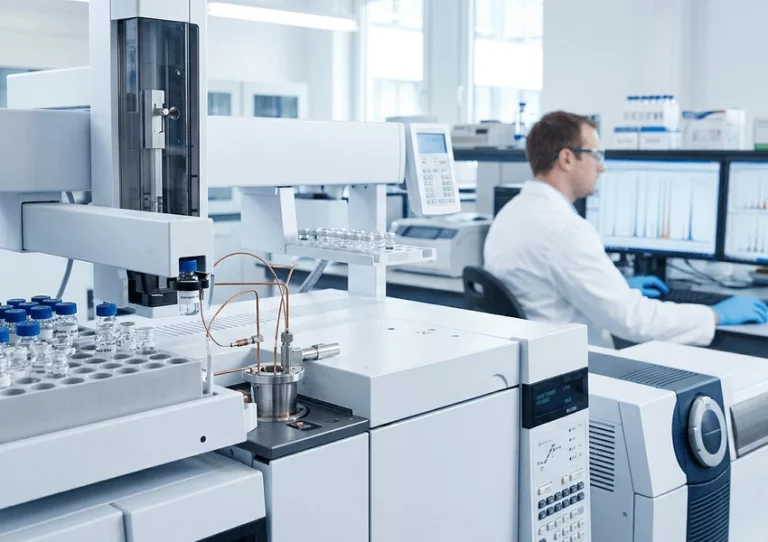
Gas chromatography works as a physical separation tool, which splits up volatile mixtures. People use it in many areas like pharma, makeup, and testing for natural toxins. This trait makes GC highly valuable. It helps a lot in impurity profiling setups that need clear separation of volatile organic chemicals.
Data Integrity and Method Transfer Issues
Moving approved impurity profiling methods between different sites brings in changes. These shifts happen because of different machine setups or varying worker skills. Typing data by hand raises the chance of mistakes. At the same time, non-digital setups make it hard to follow cGMP and ALCOA+ rules for data safety. To keep clear records across worldwide sites, labs must adopt digital tools. These platforms gather results in one place and allow easy tracking at any time.
How Can Advanced GC Techniques Overcome Impurity Profiling Bottlenecks?
Gas chromatography has grown into a must-have tool for modern pharma testing. It offers great detail and flexibility when hunting for volatile impurities.
The Role of Gas Chromatography (GC) in Detecting Volatile Impurities
GC provides high separation efficiency for volatile and semi-volatile compounds for volatile organic impurities frequently encountered in APIs. When coupled with mass spectrometry (GC–MS), it enables structural elucidation through molecular fragmentation patterns. GC/MS is also another useful method that can determine the components of a given mixture using the retention times and the abundance of the samples. Automated sampling systems integrated into modern GC setups minimize operator variability while improving throughput—an essential feature for large-scale generic drug manufacturing facilities.
Enhancing Sensitivity and Accuracy through Modern GC Systems
Thorough two-dimensional GC (GC×GC) methods boost clarity a great deal. They use back-to-back columns with different sorting traits, which allows labs to measure many trace impurities at the same time. It does this without mixing up signals from the main drug base.
Flame ionization detectors (FID) stay a solid choice to measure hydrocarbon-based impurities. They work well because they respond evenly over a wide range of amounts. Mass spectrometric detectors take this power further, and they give a firm identity to unknown compounds. They do this by matching signals against known data lists, which gives a huge edge when checking for leftover solvents or broken-down parts.
How Do Automation and Digital Integration Transform Impurity Profiling Workflows?
Automation has changed the game for lab speed, which removes the need for human hands during repeat testing loops.
Streamlining Workflow Efficiency through Automation
Auto sample injection tools lower human errors during daily tests. Robotic add-ons let machines run non-stop across different work shifts, which cuts down wait times without hurting accuracy. Such automation grants steady results under heavy workloads. These busy settings are very common in generic drug manufacturing spaces where batch release times matter a lot.
Leveraging Data Management Platforms for Compliance and Traceability
Central digital setups allow smooth links between machines, laboratory information management systems (LIMS), and electronic laboratory notebooks (ELNs). Live tracking helps managers make smart choices early, which also keeps the lab ready for sudden health board checks. This push for digital tools fits perfectly with modern cGMP goals, which highlights clear actions and easy tracking across all impurity profiling steps.
How Does PERSEE Support Reliable Analytical Solutions?
Before exploring specific solutions, it’s important to introduce who we are as a company committed to advancing analytical science globally. PERSEE is a modern high-tech enterprise integrating R&D, manufacturing, and sales of scientific instruments dedicated to empowering laboratories worldwide with innovative technologies that enhance precision, reliability, and compliance readiness across industries, including pharmaceuticals, environmental sciences, food safety, petrochemicals, and life sciences.
PERSEE’s Expertise in Gas Chromatography Instruments for Pharmaceutical Applications
The computer-controlled system, large-screen LCD, multiple temperature protections, and data network transmission make it possible to realize laboratory digital management. G5 GC combines stable gas flow control with high-sensitivity detectors to deliver accurate qualitative and quantitative impurity analyses essential for regulatory submissions in generic drug manufacturing. A configurable modular design allows users to install multiple detectors, including FID, TCD, or MS interfaces, according to analytical needs—ensuring flexibility without sacrificing precision.
Combining advanced international technologies and years of manufacturing experience in gas chromatography, the GC1100 Gas Chromatograph is developed by PERSEE. Its robust design emphasizes practicality with cost-effective operation suited for routine quality control laboratories engaged in continuous impurity monitoring programs. Automated temperature programming ensures stable performance even under variable workloads while maintaining reproducibility across extended test cycles.
The M7 Single Quadrupole GC-MS is the new generation of high-performance mass spectrometers designed by PERSEE. It integrates intelligent control software simplifying method setup and validation procedures while supporting long-term reliability under demanding production schedules typical of generic drug manufacturing sites. Its advanced quadrupole mass analyzer ensures accurate detection even at ultra-trace levels—making it ideal for identifying unknown impurities or verifying residual solvent limits per ICH guidelines.
Why PERSEE Is a Trusted Partner for Analytical Laboratories
PERSEE’s solution provides accurate and reliable results to the pharmaceutical industry, from research and drug discovery to development, manufacturing, and quality control. Our global network supports clients through technical training programs, on-site maintenance services, and application consultation, ensuring maximum instrument uptime. With decades of experience delivering robust analytical instruments across diverse sectors, we continue driving innovation aligned with evolving regulatory expectations worldwide.
Conclusion
Overcoming impurity profiling bottlenecks requires more than incremental upgrades—it demands integration between advanced chromatographic technology, automation infrastructure, and digital ecosystems that ensure both efficiency and compliance integrity throughout production pipelines. High-performance instruments exemplify this synergy by combining analytical precision with operational intelligence designed specifically for generic drug manufacturing excellence. For laboratories seeking partnership-driven innovation backed by proven reliability—we invite you to contact us today to explore tailored solutions enhancing your analytical capabilities.
FAQ
Q1: Why is impurity profiling critical in generic drug manufacturing?
A1: Impurity profiling verifies chemical purity, safety, and equivalence between generics and reference drugs—ensuring both regulatory approval processes proceed efficiently while safeguarding patient outcomes through consistent quality assurance measures.
Q2: How does gas chromatography improve impurity detection?
A2: Gas chromatography gives amazing separation power. This lets labs clearly spot volatile impurities at trace levels. When linked with mass spectrometry, it maps out chemical shapes. This step is vital to confirm a compound’s true identity during pharma tests.
Q3: What makes PERSEE instruments suitable for pharmaceutical impurity analysis?
A3: Our gas chromatographic platforms combine sensitivity enhancement technologies with automation compatibility, delivering stable performance ideal for complex impurity profiling tasks within modern generic drug manufacturing environments, supported by comprehensive technical service frameworks available globally through our expert teams.