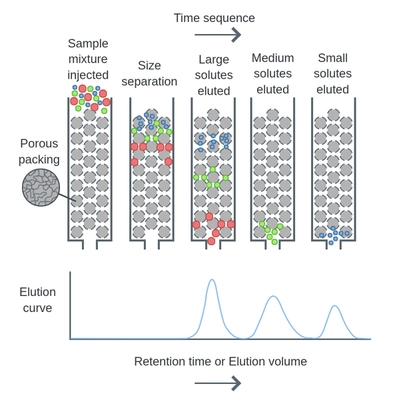
Size exclusion chromatography (SEC), also known as gel permeation chromatography (GPC), serves as a key analytical method for sorting macromolecules purely by their hydrodynamic size. The main idea relies on physical differences, not chemical ones: particles get separated through varying exclusion from the porous setup of the stationary phase. Bigger particles come out first since they cannot enter the pores in the stationary phase. Meanwhile, tinier particles slip into those pores and move more slowly along the column. This leads to longer times before they exit.
This approach gives SEC special benefits when studying polymers, proteins, antibodies, and nanoparticles. It does so without changing their natural form or needing any chemical bonds. As Held and Kilz noted, “Size-exclusion chromatography is the most important characterization technique for macromolecules.”
Which Parameters Are Critical for Analytical Accuracy in SEC?
You need to pick the mobile phase with great care to keep the sample in good shape. The makeup of the buffer has to support the sample’s stability and stop any unwanted bindings. For example, proteins react strongly to the strength of ions and the pH level. These factors directly shape their form and how they stick around in the column. Adding certain organic additives can reduce sticky hydrophobic effects. This proves especially useful when working with biological polymers.
Why Must Flow Rate Be Optimized for Best Resolution?
Flow rate plays a major role in both the sharpness of separation and the speed of the process. Faster flows cut down on the time needed for analysis, but they might harm the clarity of separation. This happens mostly for particles close to the exclusion limit. On the other hand, slower flows boost the quality of separation but drag out the total time. Therefore, you have to find a good middle ground. This way, you get strong analytical results without losing out on efficiency.
How Important Is Calibration in Molecular Weight Estimation?
SEC itself does not give exact molecular weights. Instead, it guesses them using curves made from standard samples. By calibrating with known standards, you can link elution volumes to molecular weights. This holds true especially when applying broad calibration methods, such as the Grubisic equation.
How Can SEC Be Applied to Enhance Analytical Accuracy Across Different Sample Types?
In the growth of biopharmaceuticals, spotting protein clumps stands out as a vital quality check. SEC picks up high-molecular-weight aggregates that matter a lot in controlling biopharmaceutical quality. It breaks down monomers from pairs or larger groups, which helps evaluate how stable proteins remain under different setups. Plus, through careful measurement, it tells apart the main single forms from broken-down bits.
What Benefits Does SEC Offer for Nanoparticles and Bioconjugates?
Nanoparticles and bioconjugates bring tough issues because of their varied makeup. SEC shines in this area since it sorts them by hydrodynamic radius. In particular, it divides nanoparticles according to their hydrodynamic radius, which aids in checking size evenness. For things like antibody-drug conjugates or proteins linked with PEG, it can set apart linked versions from unlinked ones.
What Instrumental Factors Should Be Considered in High-Precision SEC Setups?

Choosing the column depends on the expected range of molecular weights and how well it matches chemically. Columns have to fit the projected molecular weight range to achieve the best possible clarity. On top of that, setups meant for water-based systems work best for proteins and polysaccharides. In contrast, columns that handle organic solvents suit man-made polymers such as PMMA or polystyrene. The length and width of the column also play into the sharpness of separation and how much sample it can handle at once.
Which Detectors Add Value to SEC Interpretation?
SEC often teams up with various detectors to make the results easier to understand:
Refractive Index (RI): This provides broad detection for polymers, carbohydrates, and proteins that lack color-absorbing parts.
UV/Vis: It allows targeted detection using the way samples absorb light.
MALS: This gives true molecular weights without needing standard samples for calibration.
Running these together lets you gather data at the same time. As a result, it ties concentration levels to structural traits, allowing for a full breakdown from just one test run. This combined approach greatly strengthens the trustworthiness of the data you obtain.
Who Can Provide Reliable and Innovative SEC Instrumentation Solutions?
If you want to bring SEC into your lab with top-notch precision and flexibility, PERSEE delivers an outstanding selection of chromatographic tools designed for both research labs and industrial settings. Founded as a high-tech company focused on scientific tools back in 1991, PERSEE has stayed true to pushing forward in areas like HPLC, GC, FTIR, UV/Vis spectrophotometry, and atomic spectroscopy. Their strong focus on research shows clearly—more than 30% of the staff works in R&D, always improving products to meet what users need as things change over time.
Within their lineup, the L600 High Performance Liquid Chromatography system really stands out. Its solid build makes it perfect for detailed SEC tasks. The system ensures exact control over flow, which is crucial for getting repeatable results in separations based on molecular size. Additionally, PERSEE aids scientists worldwide with hands-on help in setup, training, and upkeep. They do this through a solid network of distributors around the globe, making support easy to access no matter where you are.
How Does SEC Contribute to Analytical Precision Across Industries?
SEC’s skill in pulling apart molecules just by their size, all while keeping native conditions, turns it into an essential tool for checking purity. It reliably spots differences between various molecular types, which boosts the strength of purity checks in many ways.SEC shows its wide-ranging usefulness from characterizing polymers in materials science, to finding aggregates in biopharmaceuticals, and sizing nanoparticles in nanomedicine. It fits smoothly into many fields, including pharmaceuticals, materials science, and biotechnology. Across these areas, it handles diverse needs with consistent performance, adapting to specific challenges in each one while maintaining high standards of accuracy and reliability.Linking SEC with tools like MALS or UV takes its ability to measure quantities to a higher level. This pairing boosts the trustworthiness of numbers you get.
FAQ
Q1: How does size exclusion chromatography differ from other chromatographic techniques?
A1: Unlike ion exchange or reversed-phase chromatography that rely on chemical interactions, SEC separates analytes solely based on their hydrodynamic size using a porous matrix.
Q2: What are common challenges in achieving accurate results using SEC?
A2: Challenges include non-specific interactions with the stationary phase, inappropriate calibration standards for complex samples, and suboptimal flow rate or mobile phase conditions.
Q3: Can size exclusion chromatography be used for both aqueous and organic systems?
A3: Yes, depending on the stationary phase material used; aqueous-compatible columns are suited for proteins and polysaccharides while organic-compatible columns are used for synthetic polymers like polystyrene or PMMA.