Routine environmental monitoring has a different rhythm from one-off research work. Samples arrive in batches, holding times matter, and the laboratory may need to report water, soil, indoor air, industrial emission, or complaint samples on the same week. A GC-MS system for environmental monitoring has to do more than identify a compound in a clean standard. It must keep retention times steady, protect the ion source from dirty matrices, and give analysts enough confidence to release results without re-running every awkward sample.
For many labs, the buying question starts with a simple point: is the work mostly known target compounds, or is the lab expected to chase unknowns? Routine environmental testing often sits on the target side. Volatile organic compounds, PAHs, PCBs, OCPs, solvents, fuel markers, and pesticide residues have known libraries, known ions, and known sample preparation paths. That makes a well-built single quadrupole GC-MS a practical fit for daily throughput, especially when the lab wants dependable quantitation and easy maintenance rather than a high-end research platform that sits idle between specialist projects.
Start With the Compounds and Sample Matrix
The first checkpoint is chemistry, not the instrument catalog. GC works best for compounds that are volatile enough and thermally stable enough to pass through the inlet and column without breaking down. Environmental work often fits this window: VOCs in air or water, PAHs in soil extracts, petroleum-related compounds, chlorinated solvents, OCPs, and many semi-volatile organics. Salts, metals, large polymers, and highly polar nonvolatile compounds belong elsewhere.
Match the Inlet to the Sample Route
A lab that runs purge-and-trap water samples has a different need from a lab using headspace vials, solvent extraction, or gas sampling valves. The sampler and inlet choice shapes sensitivity, carryover risk, cycle time, and maintenance. Splitless injection helps low-concentration extracts. Headspace or purge-and-trap fits volatile compounds. Gas valves may suit fixed-gas or air monitoring work. A buyer should ask whether the GC-MS can support the actual sample route planned for the method, not just the compound list.
Check Column Oven Behavior
Environmental runs can be long, and the column oven has to come back to the starting condition quickly enough for the next sample. Stable temperature control helps retention time repeatability, while fast cooling shortens the dead time between injections. For mixed hydrocarbon or semi-volatile methods, the oven program also needs enough flexibility to move late-eluting compounds without making early peaks broad or weak.
Decide How Much Identification Power Is Needed
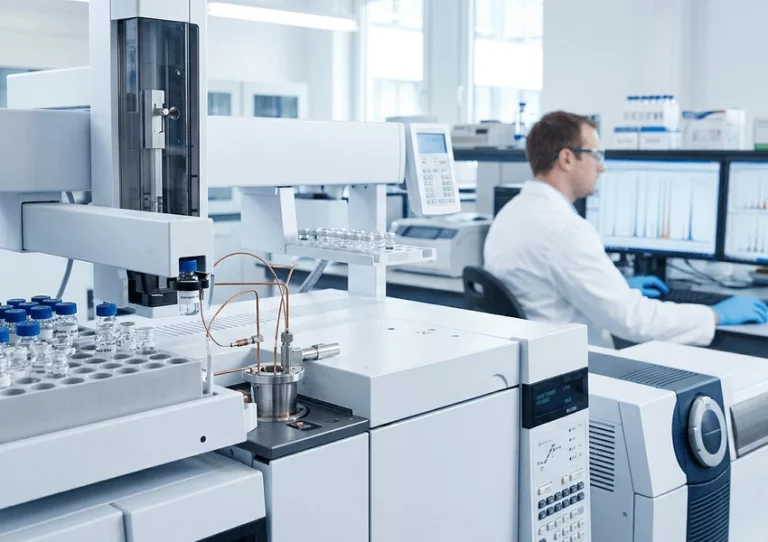
Mass spectrometry adds the confirmation that a standalone GC detector cannot provide. Retention time alone may not be enough when two compounds sit close together or when a matrix peak appears near a target. GC-MS separates the sample by gas chromatography, ionizes each compound, and creates a mass spectrum. Analysts can review target ions, qualifier ions, and library matches instead of relying on a single peak position.
Scan Mode, SIM Mode, and Daily Tradeoffs
Scan mode is useful when the lab wants broad information or needs to review unexpected peaks. SIM mode spends more dwell time on selected ions and is often preferred for trace target analysis. In routine environmental work, many methods use both ideas at different stages: scan data for screening and library review, SIM for low-level quantitation. The software should make that setup plain enough for a trained analyst to run without turning every method edit into a service call.
Quadrupole, triple quadrupole, and TOF systems all have a place. A triple quadrupole gives stronger selectivity for difficult matrices. TOF can help when accurate mass and non-target work are central. For many monitoring labs, though, a single quadrupole GC-MS remains the sensible daily tool. It is robust, familiar to analysts, and strong for known compounds where the method already defines target ions, calibrants, blanks, and QC checks.
Look Hard at Uptime, Cleaning, and Consumables
Environmental samples are rarely kind to instruments. Humic material, high-boiling residues, dirty extracts, and solvent loads all reach the inlet eventually. A buyer should ask how quickly a liner can be changed, whether the ion source is easy to reach, how filament status is checked, and what happens when a column is replaced. Small service details become large costs when a lab has dozens of samples waiting.
Vacuum and Ion Source Stability
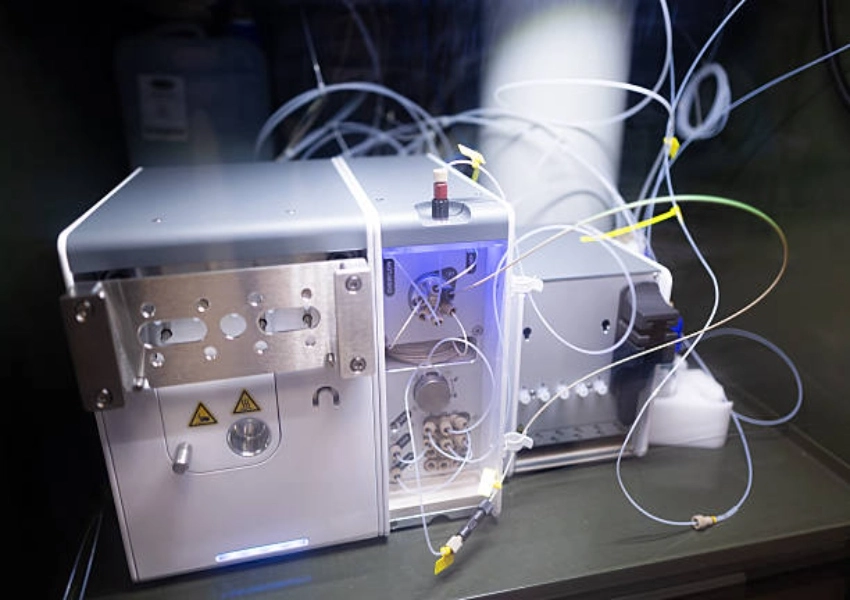
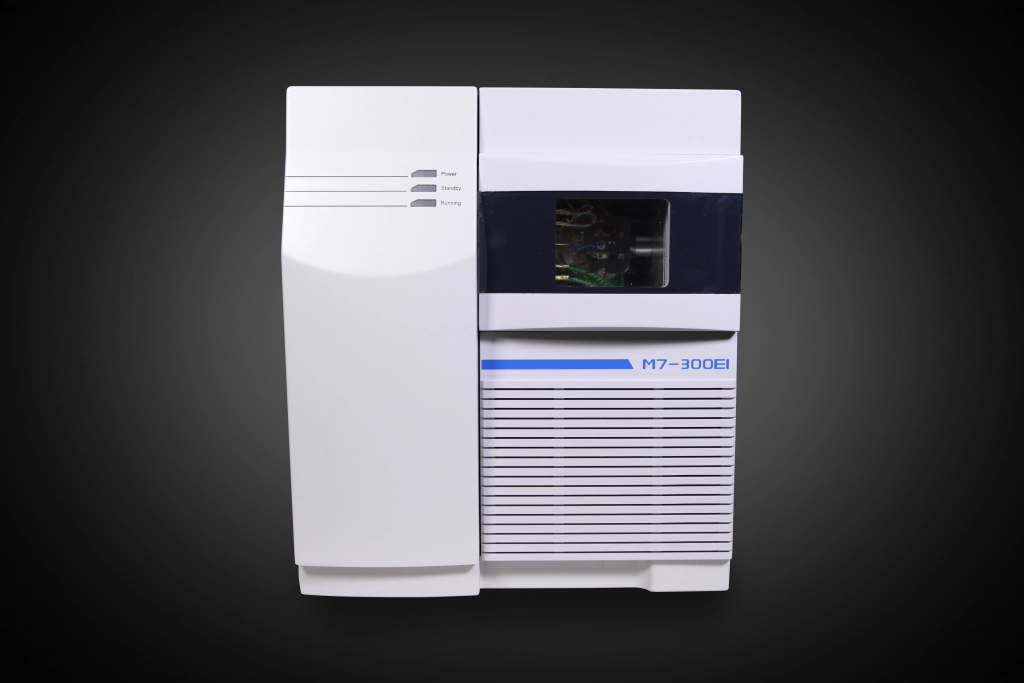
The PERSEE M7 Single Quadrupole GC-MS is built around an EI source with adjustable electron energy from 10 to 100 eV, dual filaments, and an ion source design aimed at strong focusing. Its vacuum system uses a pre-vacuum pump and turbo molecular pump to reduce ion collisions, background noise, and memory effects. Those are not decorative details. In VOC analysis and PAH and PCB analysis, a cleaner baseline and stable ion transmission make calibration checks less frustrating.
Routine maintenance also deserves attention. The der M7 front panel includes a transparent observation window for filament status and column installation checks, while the system uses a removable pre-quadrupole filter to reduce main quadrupole contamination. The injector design supports tool-free liner replacement. Those features speak to the day-to-day reality of environmental laboratory workflow, where lost time often comes from small access problems rather than the main analysis itself.
Software Should Shorten Review, Not Hide the Method
A good GC-MS workstation keeps the analyst close to the method. It should show chromatograms clearly, allow ion review without extra export steps, store methods in an orderly way, and support practical reporting. Remote support can also matter when a lab is far from the supplier’s service center. PERSEE describes the M7 GCMS workstation as intuitive and easy to operate, with a remote control function that can support technical assistance when method or instrument questions come up.
Do Not Ignore the GC Around the MS
The mass spectrometer often gets the attention, but the GC side carries much of the routine burden. PERSEE’s chromatography systems include the M7, G5 GC, and GC1100 GC lines, giving buyers a way to compare injection, detector, oven, and software needs across routine methods. The G5 GC offers optional packed column and capillary split/splitless injectors, up to three injectors, and detector choices including FID, TCD, FPD, NPD, ECD, and PID. For labs that run both GC-only and GC-MS methods, that flexibility can keep simpler tests off the mass spectrometer.
Die GC1100 GC is another useful comparison point for buyers building capacity step by step. It supports packed column and capillary split/splitless injection, optional dedicated chromatography versions such as TVOC and non-methane hydrocarbon analysis, and application coverage across environmental protection, petrochemical, food safety, quality inspection, and research. A lab may pair GC-only work with MS confirmation, or keep routine screening and confirmation on separate systems when sample volume grows.
Ask Supplier Questions Before the Purchase Order
Before choosing a GC-MS system for environmental monitoring, ask the supplier to discuss a few real sample classes. What is the expected route for drinking water VOCs? What cleaning schedule is normal for soil extracts? Which ions and library workflow are used for OCP or PAH confirmation? Can the system support the carrier gas, traps, columns, and autosampler already used in the lab? Will application support cover method transfer, not just installation?
Persee has been manufacturing analytical instruments for more than 20 years now and reports more than 30% of employees in R&D. The product range of the instrument manufacturer includes spectroscopy, chromatography, and atomic spectrometry as well as laboratory equipment. With that background of the instruments’ manufacturer, it is very important that the vendor be able to connect the design of the instruments with the corresponding methods. For a monitoring lab, the best purchase is usually the system that, in the long run, enables the continuation of the routine analysis, withstands dirty samples, and, in the end, still offers enough space for new target lists, as soon as there are changes in the regulations or from clients.
FAQ (häufig gestellte Fragen)
Q1: Is a single quadrupole GC-MS enough for routine environmental monitoring?
A1: Yes, for many target-compound methods involving VOCs, PAHs, PCBs, OCPs, solvents, and pesticide residues. More complex matrices or very low reporting limits may call for triple quadrupole or high-resolution systems, but single quadrupole GC-MS remains a practical daily platform.
Q2: What should buyers check first: sensitivity or maintenance?
A2: Both matter, but maintenance is often underestimated. A sensitive system that is hard to clean can lose more productive time than a slightly simpler system with better access, stable vacuum, clear software, and fast inlet service.
Q3: Can GC-only systems still fit an environmental lab?
A3: Yes. GC-only systems can handle established detector-based methods, screening work, or higher-volume tests. GC-MS then adds stronger confirmation for compounds where mass spectra and target ions are needed.