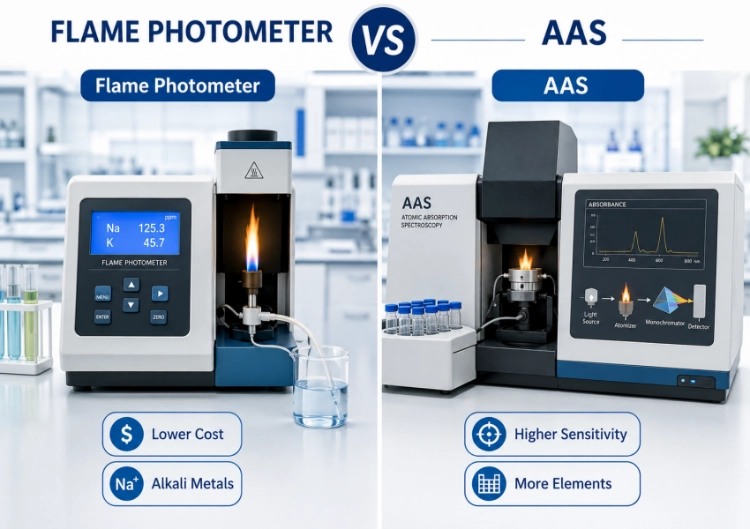
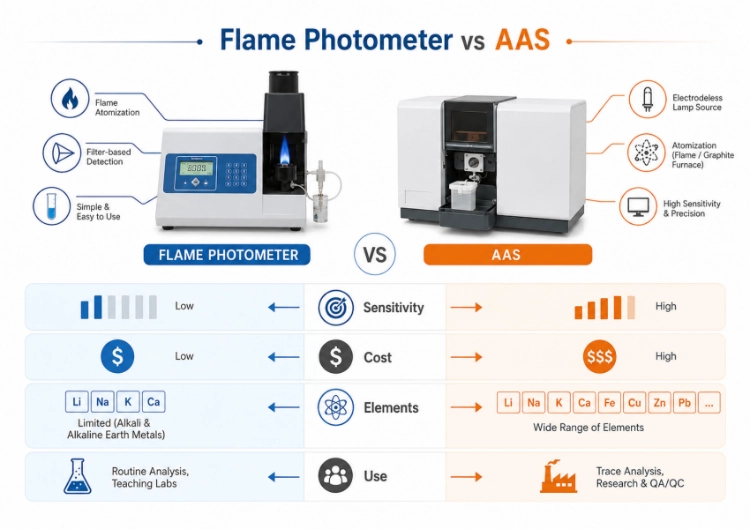
For routine sodium and potassium testing, the choice between a flame photometer and an atomic absorption spectrophotometer should be made from the sample list and the laboratory’s next two years of work. A flame photometer can be attractive when the task is a small group of alkali metals, the concentration range is comfortable, and many samples must move through the bench quickly. AAS takes more method planning, but it can bring stronger element selectivity, broader expansion, and a path into trace-metal work. That is the central flame photometer vs AAS decision for a routine laboratory.
The comparison is not simply flame emission versus atomic absorption. Sample preparation, calibration design, ionization, matrix composition, flame stability, wavelength selection, background correction, and future analytes all influence the result. A low purchase price is useful only when the instrument fits the method that actually runs every day.
What the Two Techniques Measure
Flame emission spectroscopy measures light emitted by excited atoms in a flame. Sodium and potassium are well suited to this principle because their emission signals are strong in common flame conditions. The method can be direct and fast, but emission intensity is affected by flame temperature, aspiration rate, ionization, spectral overlap, and the composition of the solution. Those factors belong in the routine element analysis risk review.
Why Flame Emission Can Be Efficient
A flame photometer is often easy to place into a high-throughput routine: prepare a liquid series, aspirate standards and samples, and monitor the response for the selected elements. It may use less sample handling than a digestion-heavy trace-metal method. That advantage is strongest when the matrix is reasonably clean and the laboratory only needs a narrow element menu. The method still needs blank checks, calibration verification, aspiration control, and a plan for dilution when samples exceed the working range.
What AAS Adds to the Decision
Atomic absorption spectroscopy uses element-specific radiation from a hollow cathode lamp and measures the absorption produced by ground-state atoms after atomization. PERSEE’s AAS describes the basic system as a light source, atomizer, optical system, and detection system, with high sensitivity and selectivity for trace elements and impurities. For sodium and potassium, AAS can be used in flame mode, while a suitable combined platform can later address analytes that need graphite-furnace sensitivity. In practice, atomic absorption spectroscopy gives the lab a broader method family than a sodium-only or potassium-only routine.
Compare Matrix Control, Not Just Signal Speed
Both methods can be affected by the sample matrix. High dissolved solids can change nebulization and aspiration. Easily ionized elements can alter the population of ground-state atoms or excited atoms. Viscosity, acid content, organic solvent, salts, and suspended material can shift responses. The remedy is method-specific: dilution, matrix matching, ionization suppression or release agents, internal standards where applicable, or a different atomization condition.
Sodium and Potassium Need Calibration Discipline
Prepare standards in a medium that matches the samples as closely as the method permits. Check the blank, calibration shape, mid-range verification, dilution agreement, and carryover after a high sample. A single strong signal does not prove accuracy. In a potassium application recorded in the PERSEE knowledge base, the sample is digested, atomized in an air flame, measured at 766.5 nm, and quantified against a standard calibration series. That example demonstrates a workflow, not a universal wavelength or acceptance limit for every matrix.
When Matrix Effects Push the Choice Toward AAS
AAS becomes more attractive when the same laboratory also measures calcium, magnesium, iron, copper, lead, or other elements, or when sodium and potassium are present in a matrix that needs more controlled background treatment. AAS does not remove preparation problems, but it gives the method developer more tools to separate an analyte signal from the sample background. Any performance claim should be verified with the actual sample type and target range.
Look at Flame, Gas, and Sample Handling
A routine element method is tied to the flame and the way liquid reaches it. Review fuel and oxidant availability, gas purity, ignition, burner alignment, drain handling, nebulizer cleaning, and the time needed to switch from one method to another. Sample volume matters too. A high-throughput laboratory may value a small, stable aspiration path, while a trace workflow may prioritize autosampling and low-volume introduction.
The Flame Is Part of the Specification
PERSEE’s A3AFG material identifies three flame options, including air/acetylene, nitrous oxide/acetylene, and air/propane (LPG). The LPG option is described as suitable for alkali metals such as potassium and sodium, especially in emission mode. That is a useful purchasing detail because a local gas supply can affect operating cost and continuity. The selected flame, burner, nebulizer, safety interlocks, and gas monitoring should appear in the quotation and site-acceptance plan, rather than being left to installation day.
The AAS Route Can Be Broader Than the Daily Test
ที่ อัน3AFG combines flame and graphite-furnace atomization, and its documentation also includes hydride-generation capability. Software controls lamp positioning, gas flow, and key operating functions; D2 and self-reversal background correction are available, and a universal autosampler can introduce standards and unknowns. For a laboratory that starts with sodium and potassium but expects a wider element list, this kind of combined configuration may have more value than a single-purpose purchase.
Decide From Throughput and Future Analytes
A flame photometer can be the right answer for a focused, stable routine. AAS is usually the stronger long-term choice when the lab needs several elements, lower-level work, matrix correction, or a route into regulated quality testing. The decision should include sample numbers, preparation time, calibration frequency, operator skill, gas costs, lamp and burner consumables, service response, and the cost of adding a second method later.
A Focused Flame AAS May Be Enough
ที่ AA990f is described as a versatile entry-level AAS with computer-controlled air/acetylene flame operation for general laboratory requirements. It can suit a lab whose main need is flame AAS and whose element list remains limited. It is a life-cycle choice for work involving fewer than eight elements, but the final fit still depends on the sample matrix, required detection capability, workload, and the specific method.
A Combined Platform Buys Optionality
ที่ อัน3G is positioned as an automatic graphite-furnace AAS with a universal autosampler option for both flame and graphite-furnace work. That makes it relevant when routine sodium or potassium measurements share a laboratory with trace metals that need a different atomization path. Buyers should ask for a method-based demonstration, not assume that a combined instrument gives identical speed or sensitivity in every mode.
Use a Practical Acceptance Test
Before purchase, test a blank, a low-level standard, a mid-range standard, a high standard, and at least two representative matrices. Repeat the middle level after the high sample to check carryover and aspiration memory. Compare calibration back-calculation, dilution recovery, replicate precision, flame restart behavior, and the time required to clean the nebulizer or burner. The laboratory should set acceptance limits from its own method and reporting purpose; no generic pass/fail number should be borrowed from a product brochure.
Check Support and Qualification Scope
Instrument capability is only part of routine element analysis. Ask for installation, gas setup, safety checks, software training, consumables, lamp availability, autosampler support, maintenance intervals, and troubleshooting responsibility. เพอร์ส provides a route to compare flame, graphite-furnace, and combined AAS configurations. For a laboratory operating under a formal quality system, the AAS IQ/OQ/PQ scope should also be clarified before the purchase order is released.
คำถามที่พบบ่อย
Q1: Is a flame photometer better than AAS for sodium and potassium?
A1: It can be better for a focused, high-throughput routine with clean matrices and a small element list. AAS is often more suitable when selectivity, trace work, matrix correction, or future multi-element testing matters.
Q2: Can AAS measure sodium and potassium in flame mode?
A2: Yes, flame AAS can be used for these elements when the lamp, flame, wavelength, calibration, and sample matrix are appropriate. The exact method must be developed or verified for the intended product and concentration range.
Q3: What should buyers compare before choosing either instrument?
A3: Compare matrix effects, calibration behavior, sample preparation, gas supply, throughput, consumables, maintenance, safety functions, service coverage, and the next elements the laboratory expects to add. A representative-sample demonstration is more useful than a single sensitivity figure.