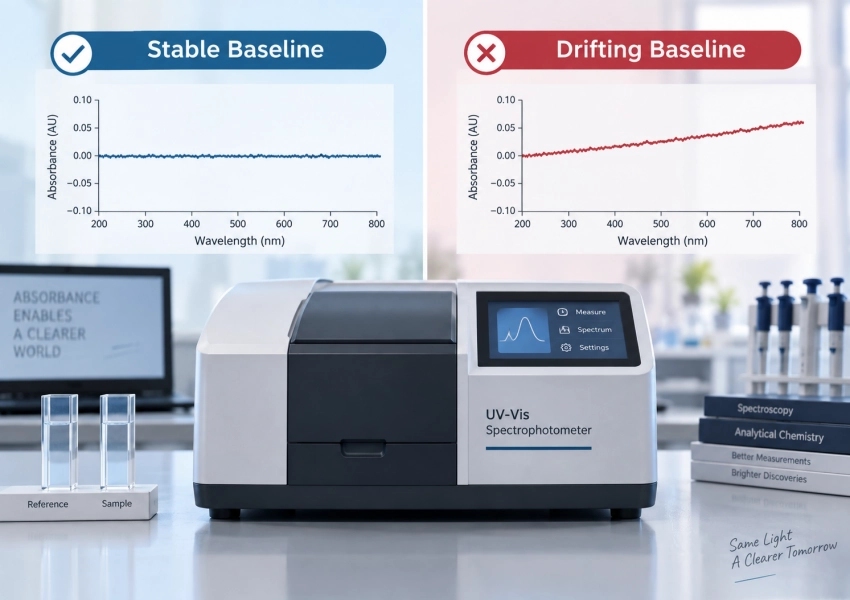
A UV-Vis run can look clean at the first blank, then slowly pull upward, downward, or sideways over the next thirty minutes. That is when a small assay signal becomes hard to defend. In long measurements, a UV-Vis baseline drift or moving spectrophotometer baseline is not just an inconvenient display issue. It can distort low-level absorbance, change a kinetic slope, or make a reference and a sample appear to disagree when the chemistry has not changed. The practical question is not simply whether drift exists. It is whether the direction, speed, and timing of the movement point to the light path, the sample compartment, the blank, or the method itself.
UV-Vis baseline drift is most damaging when the reportable change is close to the size of the movement. A high-concentration assay may tolerate a small shift. A low-absorbance release test, dissolution comparison, or long kinetic sequence often cannot. Treat the spectrophotometer baseline as a time-based performance check: run the intended blank under the same wavelength, bandwidth, cell position, temperature, and collection time planned for the method. A short baseline check cannot stand in for that exercise.
Read the Shape Before Repeating the Run
A smooth rise after startup often points toward source warm-up or temperature settling. A repeating step may track a cell change, autosampler event, or lid movement. Random spikes are more likely to involve bubbles, particles, vibration, or an intermittent electrical or optical issue. A gradual curve that appears only with a particular solvent or sample matrix deserves a separate blank investigation. Recording the timestamp, wavelength, absorbance direction, and any operator action turns a vague UV-Vis problem into a useful fault pattern.
Common Causes of Baseline Drift in Long Measurements
Several sources can act together. Many UV-Vis problems look similar at the screen, so the first pass should isolate them rather than replacing parts at random. Start with an empty-cell or matched-cell baseline where the procedure permits, then a fresh method blank, then the actual sample sequence. That simple order separates much of the instrument path from solvent, cuvette, and sample behavior.
Lamp Output and Thermal Settling
Deuterium and tungsten sources do not behave identically across the range, and a lamp that is still settling can show up as a drifting baseline. Allow the warm-up period specified in the laboratory procedure, particularly before a long UV measurement. Check lamp-hour records as well. The Pansiyon T6U uses deuterium and tungsten lamps with self-timers, while the lamps are designed for straightforward replacement. A gradual change that is present with clean matched cells and a fresh blank is a sensible reason to review source condition before changing the method.
Reference Path, Cuvette, and Blank Mismatch
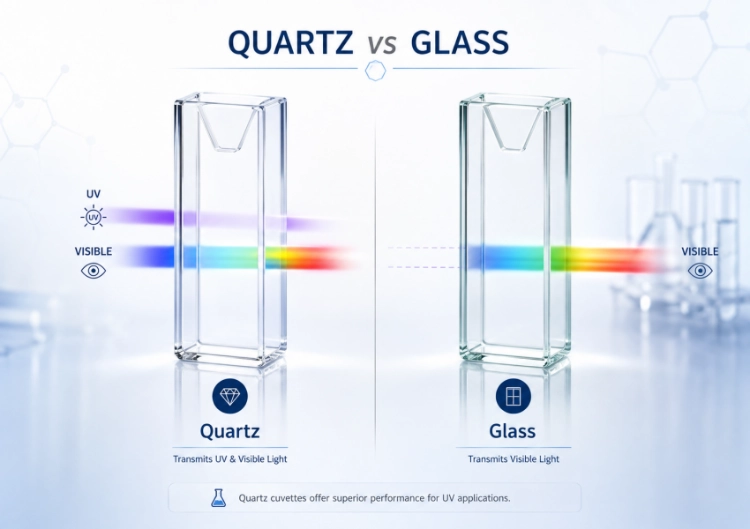
A scratched cuvette, fingerprints, evaporation at an uncovered cell, or a reference solution that does not match the sample solvent can move the baseline over time. Temperature differences between blank and sample also change refractive behavior and can alter the apparent trace. Use clean, matched cuvettes in the same orientation. For a long sequence, cap volatile samples where appropriate, let blanks and samples equilibrate, and inspect the cell faces under consistent light. If changing only the cuvette changes the trace, the instrument is not yet the leading suspect.
Bubbles, Particles, and Changing Sample Conditions
Bubbles can enter after mixing, while suspended material may settle during a kinetic run. Both effects can masquerade as baseline instability. Review whether the method calls for filtration, degassing, controlled mixing, or a defined wait time. Do not add those steps casually after a failed run; document them, assess their effect on recovery, and carry them into the validated procedure if they become necessary. A baseline that is stable with solvent but drifts only after sample introduction is usually a sample-handling clue.
Separate Optical Drift From Method Drift
The fastest troubleshooting route uses a small set of controlled comparisons. The goal is to find the first condition under which the trace becomes unstable. That makes it easier to decide whether maintenance, a new blank strategy, or a method change is justified.
Use a Short Diagnostic Sequence
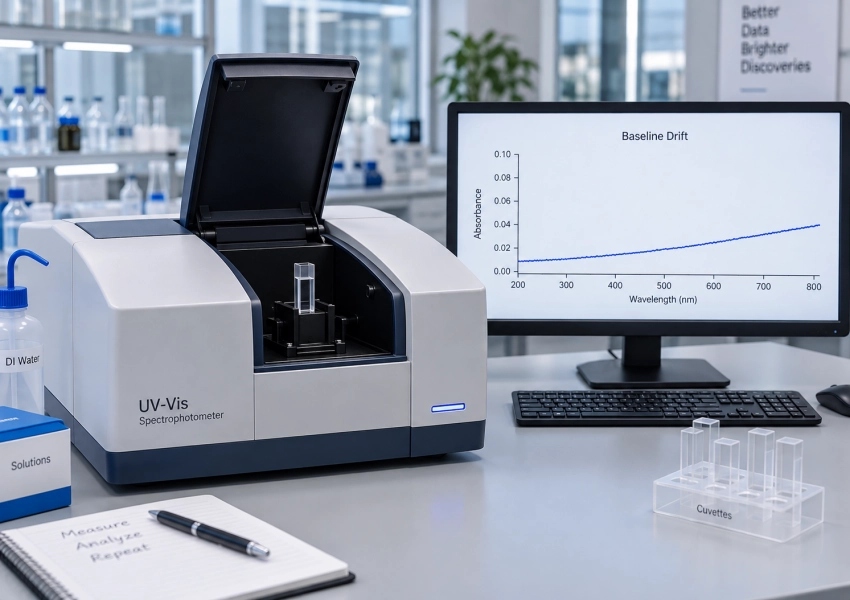
Run the intended wavelength with no cell, then with matched clean cells, then with the method blank, and finally with a representative sample. Repeat the sequence after the normal warm-up interval. Keep the bandwidth, scan mode, integration time, and cell holder unchanged. If the signal changes only after a particular accessory is fitted, inspect that accessory and its positioning. If the drift changes when the room conditions change, note airflow, temperature, and light exposure around the instrument rather than treating the observation as an unexplained software event.
Check Wavelength and Stray-Light Risk in Context
Not every unstable result is a baseline issue. At demanding wavelengths or high absorbance, wavelength error, bandwidth choice, and stray light can change the observed response. The T7DS double-beam configuration combines ratio optics with a variable-bandwidth design and pre-aligned deuterium and tungsten lamps. That is relevant when a long measurement also requires repeatable scans or narrow spectral features. For method-specific acceptance limits, the laboratory should still verify performance with suitable reference materials and its own approved protocol.
Build Baseline Stability Into the Method
A resilient method spells out more than wavelength and cell path length. It defines warm-up, blank composition, cuvette handling, sample preparation, measurement sequence, reintegration rules if used, and the point at which a run is rejected. Baseline stability belongs in that set of controls because it affects the validity of the reported absorbance, not merely the appearance of the graph.
Set a Meaningful Time Window
Test stability for the actual duration of the routine batch, not for a convenient five-minute demonstration. A formulation assay measured over forty minutes should have a stability check that covers that period. Kinetic work needs an even closer match to its acquisition timing. Trend the blank and control response over several days. A slow change across days can reveal a lamp, cleanliness, or environmental issue long before it becomes a failed batch.
Keep Maintenance Linked to Evidence
Routine care is most useful when it follows observed performance. Clean the accessible optical and cell-compartment areas as allowed by the instrument procedure, inspect holders for damage, and replace consumables on a documented schedule. The sealed monochromator and precise stepper-driven grating described for the T6U are useful design features, but they do not remove the need for method blanks and performance checks. A maintenance record should connect an intervention with the reason it was made and the verification that followed.
Choose an Instrument Around the Actual Stability Risk
For ordinary fixed-wavelength work, a compact split-beam instrument may be appropriate when the method has a modest time window and controlled sample preparation. The T'nin6İÇİNDE UV–V'ninis spectrophotometer offers a 190-1100 nm range, stated wavelength reproducibility of no more than 0.4 nm, and low stray-light performance below 0.05%T. Those figures are starting points for a suitability discussion, not a substitute for running the laboratory’s blank and control materials.
More demanding work may call for higher sensitivity, adjustable bandwidth, accessories, or stronger stability evidence. The T8DCS uses true double-beam optics, a photomultiplier detector, and a continuously selectable 0.1-5 nm bandwidth. Its UV-Win software is supplied as standard. Where deep-UV work or a broad photometric range matters, the T9DCS is listed with very low stray light at 220 nm and optional nitrogen-purged optics. Review the intended wavelength range, sample absorbance, accessory needs, and data-handling workflow with the supplier before purchase.
Sık Sorulan Sorular
Q1: Can a baseline drift even after the instrument has warmed up?
A1: Yes. Warm-up removes only one possible cause. Blank mismatch, cuvette contamination, evaporation, sample settling, temperature change, and accessory positioning can still move the baseline during a long measurement. These UV-Vis problems need separate checks.
Q2: Should baseline correction be used to fix every drifting trace?
A2: No. Correction may be appropriate only when it is defined and assessed in the method. It should not hide a changing blank, a failing lamp, or an unstable sample condition.
Q3: Which details should be discussed with a UV-Vis supplier for long methods?
A3: Provide the wavelength range, expected absorbance, run duration, solvent and temperature conditions, cell type, accessories, and data requirements. PERSEE can then be matched to a practical evaluation using representative blanks and samples.