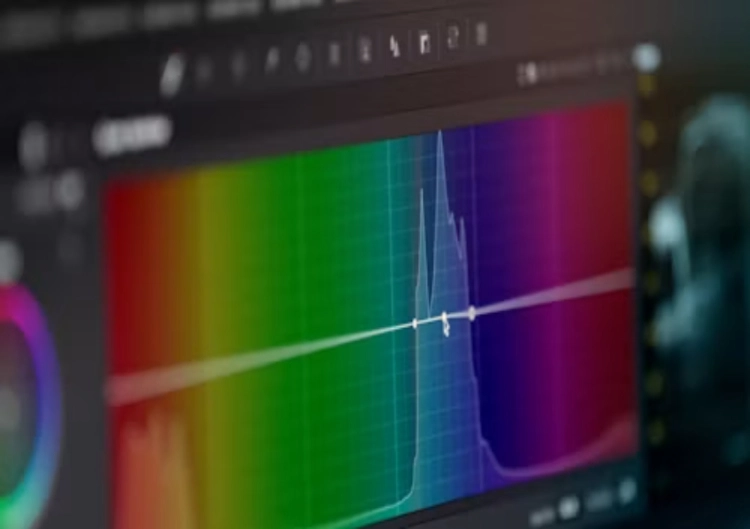
Spectral bandwidth can change a UV-Vis result more than many laboratories expect. A narrow setting may reveal a shoulder that disappears at a wider slit. The same narrow setting can also reduce the light reaching the detector, leaving a noisy trace that is difficult to use for routine quantitation. There is no single best value for every sample.
The useful question is practical: what setting preserves the feature the method needs without sacrificing too much signal or repeatability? For buyers, spectral bandwidth UV-Vis capability should be judged against actual samples, not the smallest number printed in a specification table.
Bandwidth Changes the Spectrum the Lab Actually Sees
A monochromator does not deliver one perfectly isolated wavelength. It passes a band of wavelengths around the selected point. When that band is wide relative to a sample feature, nearby absorbance is averaged into the reading. Peaks may look lower and broader, two close features may merge, and the measured maximum can shift slightly.
Narrow Features Need More Separation
Closely spaced peaks, sharp bands, derivative work, and spectral identity comparisons usually put more pressure on UV-Vis resolution. A narrower slit can preserve peak shape and expose a shoulder that matters to identification. It is still necessary to check the result with the real solvent, cell, and concentration. Resolution gained on a clean reference may vanish in a turbid or strongly absorbing matrix.
Broad Bands Often Tolerate a Wider Setting
Many routine colorimetric assays use broad absorption bands. In that situation, a wider spectrophotometer bandwidth may give a steadier signal without changing the analytical decision. The T6U provides a fixed 2 nm spectral bandwidth, a 190 to 1100 nm operating range, split-beam optics, and a listed stray light of 0.05%T. That makes it a relevant comparison point for stable routine methods that have already shown 2 nm to be suitable.
Read Resolution and Sensitivity Together
Bandwidth decisions are a tradeoff, not a ranking. Closing the slit limits the wavelength spread, but it also limits radiant power. The detector or electronics may need more gain, and baseline noise can become more visible. Opening the slit brings more light through. Signal quality may improve, although fine spectral detail can be lost. That is why UV-Vis resolution cannot be assessed separately from the usable signal.
When a Narrow Slit Costs Too Much Signal
A very narrow setting can look impressive on a reference scan and perform poorly on a low-concentration sample. Before adopting it, compare replicate scans, baseline noise, peak height, wavelength position, and calculated concentration. If the trace becomes unstable or the quantitation spreads, the method may be paying too much for resolution it does not use.
When a Wider Slit Hides Useful Detail
The opposite failure is easier to miss. A smooth, quiet trace may look better while a narrow band is being averaged away. This matters when a small shoulder separates the target from an interferent or when a spectral ratio is part of method acceptance. UV-Vis sensitivity should therefore be reviewed alongside selectivity. A larger signal is not automatically a more useful signal.
Choose the Setting Around the Analytical Task
Method development usually benefits from two stages. First, use a setting that reveals the spectral shape and possible interference. Then test a practical range around that value under the conditions used for reporting results. The final choice should survive changes in analyst, day, lamp hours, and representative sample matrix.
Use Scanning to Find the Risk Area
A scan can show whether the target band is broad, whether nearby features overlap, and whether the baseline rises in a difficult wavelength region. Scan speed and data interval need to be kept consistent during comparison. Otherwise, an apparent bandwidth effect may actually come from different point spacing or response time. These spectroscopy settings should be locked before comparing slit values. The T7D supports photometric work, spectrum scans, quantitative determinations, DNA/protein analysis, a fixed 2 nm slit, a motorized eight-cell changer, and UV-Win functions for method and data storage. It suits laboratories that need scanning functions but can standardize around that fixed bandwidth.
Set Quantitative Methods by Evidence
For quantitation, compare more than the peak maximum. Review calibration slope, linearity over the working range, repeatability, blank response, and recovery from representative samples. Keep wavelength, spectrophotometer bandwidth, cell path, scan or read mode, and temperature in the method record. If changing bandwidth alters the result beyond the laboratory’s acceptance criteria, that setting is part of the validated method and should not be treated as an operator preference.
Do Not Let Other Settings Masquerade as Bandwidth Effects
Several variables move at the same time during a hurried comparison. Concentration changes, unmatched cuvettes, lamp warm-up, solvent background, scan speed, and stray light can all alter peak shape or noise. A clean bandwidth study holds those conditions steady and changes one setting at a time.
Check Stability During Longer Runs
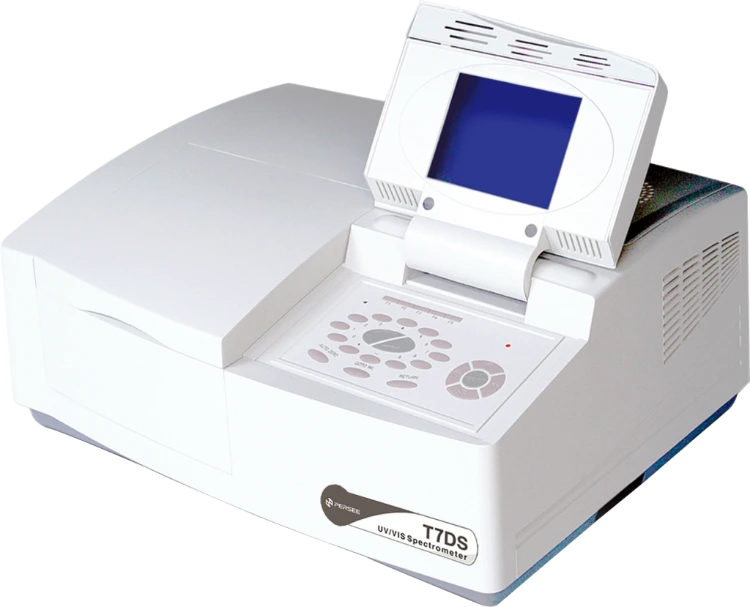
Double-beam operation can be useful when a method needs to follow sample and reference channels through a longer sequence. The T7DS는 uses double-beam scanning optics, holographic grating, pre-aligned deuterium and tungsten lamps, an automatic eight-cell holder, and software functions that include spectrum work, quantitative analysis, data storage, and GLP administration. Buyers should ask the supplier to confirm the available bandwidth configuration for the exact T7DS quotation rather than infer a slit range from the series name.
Include Stray Light and Verification
A narrow bandwidth cannot repair high absorbance error caused by stray light. Nor can a wide bandwidth solve a contaminated cell or an unstable blank. Qualification should cover wavelength and photometric checks appropriate to the laboratory, followed by a method test at the intended bandwidth. Reference materials, acceptance limits, and test conditions must come from the laboratory’s procedure or a confirmed supplier protocol.
Buy Only the Bandwidth Range the Methods Can Use
Variable bandwidth is valuable when a laboratory handles narrow and broad features, transfers methods from different sites, or expects research work to change. It adds less value when every approved assay uses a broad band and the same fixed setting. The T8DC offers continuously selectable 0.1 to 5 nm bandwidth, true double-beam optics, a Czerny-Turner monochromator with a holographic grating, photomultiplier-tube detection, automatic wavelength correction, and UV-Win software. Those capabilities provide room to study spectroscopy settings instead of accepting one slit for every method, while the detector design supports demanding UV-Vis sensitivity work.
An acceptance demonstration should use at least one broad-band routine assay and the narrowest meaningful feature in the laboratory’s workload. Compare repeatability, noise, peak separation, and calculated result at the proposed settings. A second spectral bandwidth UV-Vis run on another day is useful because a one-off trace can hide a marginal choice. 페리 can then confirm the installed optical configuration, software, accessories, and qualification support against that test plan. The purchase case becomes much clearer when the method, rather than the brochure, defines the required range.
FAQ는
Q1: Does a narrower UV-Vis bandwidth always improve the result?
A1: No. It can improve separation of close or sharp features, but less light reaches the detector. Noise and repeatability may worsen, especially in low-concentration or difficult samples.
Q2: Is a fixed 2 nm bandwidth enough for routine analysis?
A2: It can be enough for broad-band methods that have been tested at 2 nm. Narrow features, spectral ratios, or mixed research work may justify variable bandwidth.
Q3: What should a buyer request during instrument acceptance?
A3: Use representative samples and compare noise, repeatability, peak shape, separation, and calculated results at the required settings. Ask the supplier to document the installed slit configuration and test conditions.