
A dissolution result can look tidy on the screen and still be wrong. The trouble often starts before the cuvette reaches the instrument: a sample is drawn from the wrong location, a filter removes part of the analyte, a bubble sits in the light path, or the reference solution does not match the vessel medium. In a busy pharmaceutical laboratory, these small differences can turn a real release decision into a false pass or a false fail.
Reliable UV-Vis dissolution testing is less about pressing the read button and more about keeping the sampling chain consistent. The vessel condition, sampling time, temperature, path length, wavelength, blank, and calculation model all have to support the same method. Instrument capability matters, but it cannot repair a sample that was collected inconsistently.
Why Dissolution Results Go Wrong Before the Photometer Reads Them
The first control point is the method around the instrument. A lab may have a stable spectrophotometer and a sound calibration curve, yet obtain different answers because the aliquots do not represent the vessel at the stated time point. Sampling and sample conditioning deserve the same attention as wavelength selection.
Sampling Is Part of the Method
Record the exact sampling time, location, volume removed, replacement volume, and handling delay. Sampling too close to a tablet, paddle, vessel wall, or settled particle layer can bias the concentration. A manual draw also creates operator-to-operator variation. When several vessels and time points run together, an autosampler or controlled pump path can reduce timing drift, but only after the sampling position and rinse sequence have been checked.
Bubbles, Turbidity, and Particles Need a Decision
A bubble crossing the beam can produce a transient signal that looks like a concentration change. Fine particles and undissolved material can scatter light, while a cloudy medium may add background absorbance. The method should state whether the aliquot is filtered, allowed to settle, centrifuged, or measured as collected. A clear-looking sample is not automatically free of optical interference, so outlier readings should be checked against the cell, not simply averaged away.
Control the Sample Path and the Reference
False pass or fail decisions often come from a mismatch between the sample path and the reference path. The same solvent or dissolution medium should be used for blanks and standards unless the validated method requires another arrangement. Cuvette orientation, cleanliness, fill height, path length, and rinse practice also need fixed instructions.
Filtering Can Change the Measured Dose
A filter may remove particles as intended, but it can also adsorb part of the dissolved compound or contribute extractables. Before routine use, compare filtered and unfiltered controls where the method permits, run a filter blank, and check whether the first portion of filtrate behaves differently from later portions. Filter material, pore size, wetting solvent, and contact time belong in the method record. If filtration is not part of the validated procedure, adding it only to make the solution look clearer creates a new source of bias.
Blank Matching Is More Than Zeroing
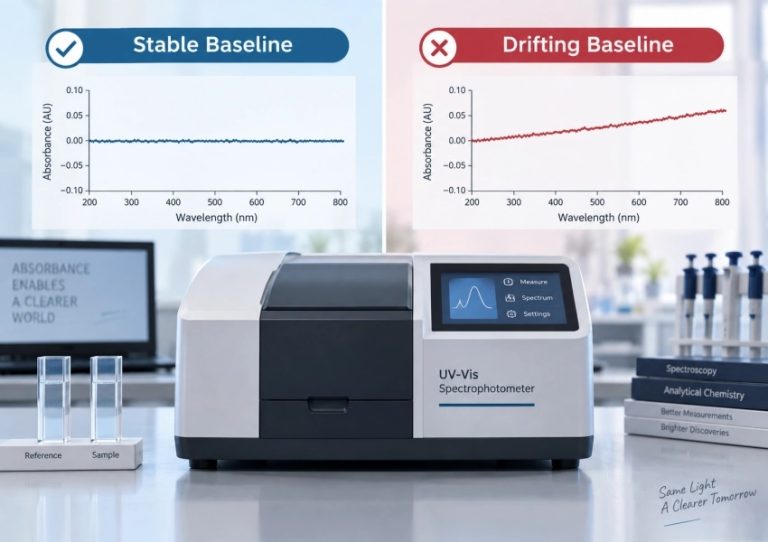
A blank should represent the optical background of the measurement, including the dissolution medium and any permitted sample preparation step. A water blank may be inappropriate for a buffer or surfactant medium. Check the blank at the working wavelength, watch for drift during a long sequence, and repeat the reference when the vessel temperature or medium condition changes. A stable zero does not prove that the blank is chemically suitable.
Set Wavelength, Bandwidth, and Temperature for the Method
UV-Vis measurement settings affect both sensitivity and the usable linear range. A wavelength near the analyte response maximum can improve sensitivity, but a crowded spectrum, steep background, or high concentration may call for a different point. Spectral bandwidth also matters: too wide a band can smooth narrow features and alter apparent absorbance, while an unnecessarily narrow band can increase noise and slow the sequence.
Match the Optical Setup to the Concentration
Check the working absorbance range with standards or representative samples instead of assuming that every time point fits the same dilution. If the signal is too high, a validated dilution or shorter path length may be needed. If the signal is too low, dilution and extra handling can make the result less reliable. The Il T8DCS spettrofotometro supports a continuously selectable 0.1-5 nm spectral bandwidth and can be configured with dissolution-related accessories, which gives a laboratory room to match the optical and sampling setup to its method.
Keep Temperature and Throughput Together
Dissolution is temperature-sensitive, and a delay between vessel sampling and measurement can change the result. A thermostatic holder, consistent transfer time, and defined queue order help keep the reading tied to the sampling event. For laboratories that run several vessels, double-beam UV-Vis equipment can support stable comparative measurement, but the temperature record and sampling sequence still need to be controlled outside the optical system.
Turn Instrument Features into a Repeatable Workflow
Automation is useful when it removes a known source of variation. It is less useful when it hides a poorly defined method. Procurement teams should map each requested accessory to a step that is currently slow, inconsistent, or difficult to audit.
Use Automation Where Timing Is the Risk
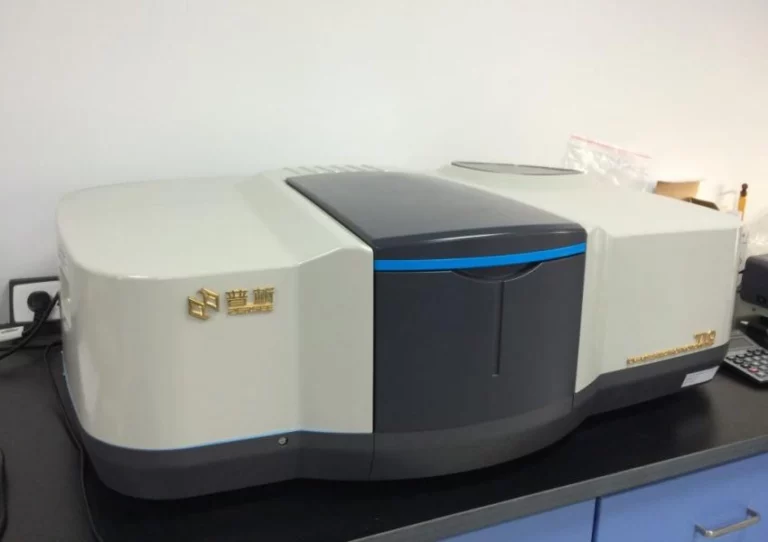
An automatic eight-position sample holder and a peristaltic pump can help a lab manage repeated sampling, while a manual workflow may still be appropriate for low-volume development work. The Il T7DS UV-Vis system is documented with double-beam optics, an automatic eight-cell changer, and peristaltic pump sampling accessories. The right choice depends on vessel count, time-point spacing, sample volume, cleaning practice, and whether the accessory path has been qualified for the product and medium.
Treat Data Review as Part of the Test
A dissolution sequence should leave a usable record of method settings, blanks, standards, sample identifiers, exceptions, and calculations. UVWin is described as providing instrument control, data acquisition, quantitative and kinetic workspaces, user groups, password controls, and an audit trail. Those functions are useful for a controlled workflow, but the laboratory still has to define roles, review points, backup practice, and the conditions for repeating a reading.
Check the Validation Boundary Before Purchase
No instrument page can establish that a specific dissolution method is valid for every dosage form. Before purchase or method transfer, ask for a demonstration using the actual medium, expected concentration range, cell type, sampling accessory, and sequence length. Review carryover, cleaning, temperature control, lamp warm-up, wavelength verification, and the handling of cloudy or particulate samples.
Ask for Evidence That Matches the Workflow
A useful supplier discussion covers more than the nominal wavelength range. Request the configuration drawing, accessory contact materials, sample path dimensions, pump tubing options, software permissions, service intervals, spare-part availability, and training scope. Persee can serve as the starting point for comparing molecular spectroscopy options, while method suitability remains the laboratory’s responsibility.
Separate a Bad Result from a Bad Method Step
When a result is unexpected, repeat the measurement only after checking the sample history. Compare the original and replacement aliquot, inspect the cell for bubbles, verify the blank, review the filter test, and confirm the calculation dilution. That sequence often reveals whether the issue sits in dissolution behavior, sampling, preparation, optics, or data handling. A repeat reading without that review can reproduce the same mistake more neatly.
Domande frequenti
Q1: Can UV-Vis replace every dissolution test method?
A1: No. Suitability depends on the drug, medium, concentration range, interference profile, sampling design, and the laboratory’s validated procedure. The instrument is one part of the method.
Q2: Why can a clear dissolution sample still give a wrong result?
A2: A clear sample may still have bubbles, an unsuitable blank, filter adsorption, temperature differences, incorrect dilution, or a sampling location that does not represent the vessel.
Q3: What should be checked when buying a UV-Vis dissolution setup?
A3: Check the optical range, bandwidth control, cell and temperature accessories, sampling path, software permissions, cleaning procedure, service support, and a demonstration using the real medium and concentration range.